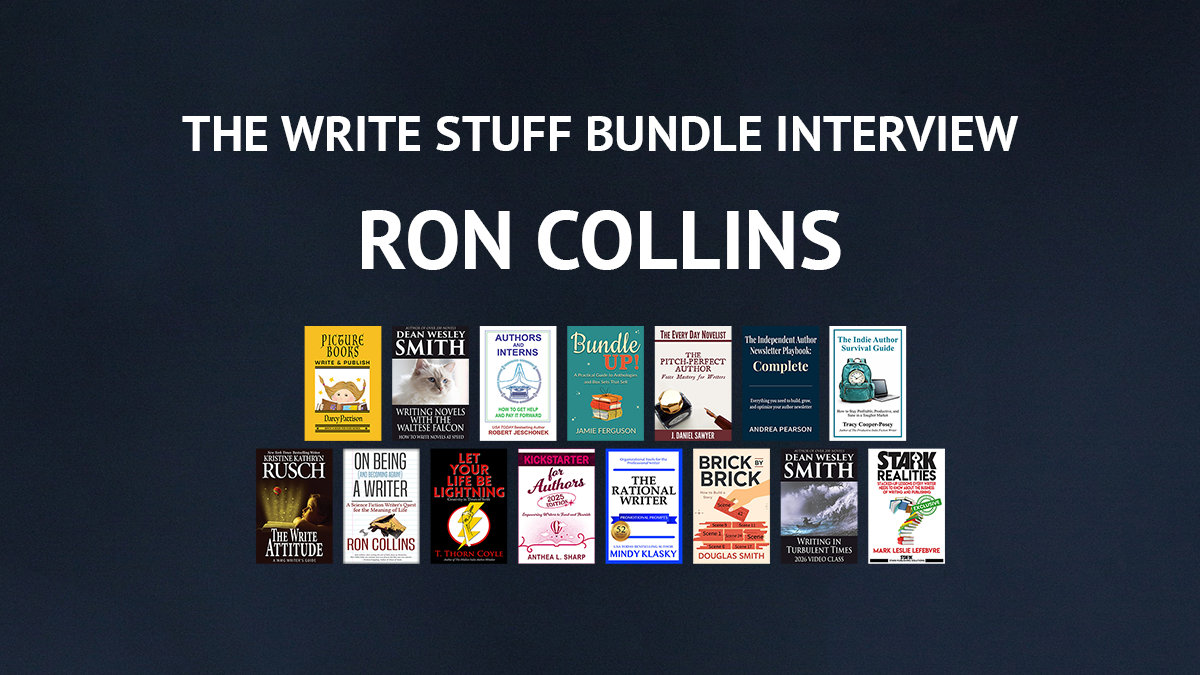
Interview: Ron Collins on On Being (And Becoming Again!) A Writer

Ron Collins is an award-winning science fiction and fantasy author with around thirty years of writing under his belt. His book in the Write Stuff StoryBundle is On Being (And Becoming Again!) A Writer—a collection of eight essays about what it means to live a creative life, written during a time when Ron was finding his way back to his own creativity after going through some pretty tough times. Ron’s book is honest, vulnerable, and surprisingly practical.
This is the third book in Ron’s On Writing series, after On Writing (And Reading!) Short and On Creating (And Celebrating!) Characters—both available at skyfoxpublishing.com.
The Interview
You open the book by taking on those stock answers writers give when someone asks why they write—“because I can’t not write,” “because I want to change the world”—and arguing that none of them are actually correct. You’ve figured out your own answer to the question. How did this realization change the way you look at writing?
I admit that I wonder whether I would have had the same answer to the question of why I write five years ago. And five years before that. So, you know, whatever. I think we change over time, but right now, coming out of the funk I’d been in while I wrote this book, I realized that the reason I write is to be close to myself. And by that I mean, to write the way I want to write requires me to get inside myself. I’m no psychologist, but to me, one of the worst things about stress in whatever form it comes in is that it can make me dissociate from myself. Just kind of go on rather than experience things. Maybe that sounds like too much woo-woo, but there’s something there.
Asking about how this changed my perspective, then, is even more interesting. I like it.
I think I’m seeing writing for the gift it is. This process has felt like returning to an old friend. It’s very comfortable. I see now that I moved away, not the writing. The writing was always there, waiting patiently. So, yeah, that’s a great question.
My writing feels very loyal to me right now, if that makes sense. It could have been jealous and run away forever, which I guess I was afraid it might. But it didn’t.
I’m sure I’ll wake up some morning a week from now and have a better answer, but this works for me today.
You’ve described this book as something your brain wrote to heal itself—that you wrote when you were coming out of a pretty significant funk. How do you write honestly about struggling with creativity while you’re still in the middle of the struggle? Did the writing itself help? What would you say to someone who’s in that same type of place right now?
I also said somewhere in the book that I didn’t know I was writing a book until I was partially through it. Mostly, at that point my brain wasn’t giving me fiction very well, so I was writing what my brain would write. I could squeeze stories out, but it wasn’t pleasant. There was a lot of friction to my fiction!
So, finally, I gave up and just told my brain I was fine to write whatever it wanted to write.
I think the process helped—probably because letting my brain be free to be creative in its own way removed pressure and let me retrain myself on how it felt to get things done every day. This book wasn’t on the business plan, after all.
For me, everything about this game is keeping myself in the right emotional frame to do the work, so that’s what I’d say to someone in the same place. Find something that your brain will focus on, and let it do that thing. It felt uncomfortable in the moment, but eventually things worked out.
DeAnna’s blurb on the book cover says that most writers who tackle this kind of book focus on themselves, but instead you help readers examine their own process. What did you have to resist doing—or maybe even unlearn—to write it that way?
Thinking about it, writing On Being (And Becoming Again!) A Writer felt a lot like back in the days when I was keeping a more introspective blog, or a Web Log, which we called those, way, way back then. I was a young father back then, though, and writing about life that happened while I was becoming a writer. So, my introspection was on broader topics.
What I’m saying is I don’t know that I resisted or unlearned anything writing this book, but that maybe I fell back on some old roots. The difference was that I was pointing the lens at myself rather than the world around me. Maybe this is as close as I can come to journaling.
This is the third book in your On Writing series, after On Writing (And Reading!) Short and On Creating (And Celebrating!) Characters. How do the three books connect with and complement each other, and do you have more books planned in this series?
When I wrote On Writing (And Reading!) Short, I had no intention of writing more. But I found it was really fun, and then at some point, someone said I could do something on characters. The idea of using characters to talk about characters seemed like a great way to geek out on fandoms at the same time as I explored that facet of storytelling, so next thing you know I had On Creating (And Celebrating!) Characters, too.
I had such great responses to them, including a few readers who have given me assignments to write at least two others that I liked well enough that I already had plans to write them before On Being (And Becoming Again!) A Writer crashed the party.
Ultimately, I guess this makes On Being (And Becoming Again!) A Writer a happy accident. I wasn’t planning it. But surprise! It pushed its way in between them. It’s probably fair to say that if I hadn’t written the two prior, I may not have even recognized I was writing this as a book. So maybe those two manifested their brother. I kind of like that.
Regardless, I suspect I’ll be doing more.
The book covers some things that don’t come up much in discussions about creativity—habits, what “fun” actually means for a writer, nurturing the creative mind. What was the biggest lesson you learned from delving into these topics?
The idea that writing is supposed to be fun is always interesting to me. I hear that all over the place, and I get it. On one hand, that’s true enough. But on the other hand, it’s a very strange sort of fun. For me, the act of writing well can be difficult and frustrating. Very emotionally taxing.
Through writing this book, as well as through talking to other writers during this time, I’ve come to realize that I equate the idea of choosing the lifestyle of a dedicated, professional writer to the idea of deciding to be a seriously competitive athlete.
I say that because when I was in high school, I played competitive basketball. I wasn’t that great, but I played hard. And at some very high level of abstraction, playing basketball at that time was “fun.” The highs were great, and when things were flowing, there was nothing better. And as a rule, practicing was often fun, too. But being a competitive athlete means practicing every day, whether you are motivated or not. It means making mistakes. It means realizing you are not the very best because the best is almost impossible to define beyond the scoreboard. It means dealing with pain every day. Both emotional and physical. I remember there were nights I’d come back from practice with my legs cramping so bad that my mom would literally pound on them for thirty minutes or so.
This is not “fun” as the world often uses the term.
But the hard work is what makes it great. That’s the learning.
The hard work is the benefit. The ability to sit in my office and make the decisions I make, as hard as that is sometimes, is what leads to the fun.
I often hear people say that a writer is the worst judge of their own work, and I agree completely with that. At least most of the time. When I’m finished with something, however, I do know if I’m proud of it.
For me, that matters.
Unfortunately, this is a lesson that I seem to need to re-learn again and again.
Sometimes, when the words are flowing, that high is intense. Other times I need to remind myself that if it wasn’t difficult, then it wouldn’t be as valuable.
You’ve been writing science fiction and fantasy for about thirty years. What has surprised you most about your writing career? Has it gone in the direction you thought it would?
My writing life has been very different from what I envisioned, mostly because when I started, the entire idea of what it meant to be an independently published writer did not exist. I didn’t expect to have this opportunity. Didn’t expect to be able to do my own thing.
A lot of that is business rather than creation. I mean, I didn’t expect to be needing to understand things like book and cover design, or the nuances of distribution through internet platforms and all the many nuances of running a publishing business that exist as soon as you decide to go the indie route.
But it’s all great, really.
I love being able to decide what I’m going to work on at any particular time.
What are you working on now—and what’s fun or exciting about it?
Oh my. Right this moment, my cup of wanna-dos runneth over.
I’m working on another three Cruise Brothers books—which is a collaborative series with my brother, who is a musician in LA. These books are just wacky fun riffs off Scooby Doo in space, and follow a pair of twin brothers who form a band that plays intergalactic space cruise ships and inadvertently solve major crimes along the way. We released three books last year, and have three more in work. The books come with Jeff’s music, both in the audio books, and as a side album released with each season. Much fun. Maybe this time we can actually release on vinyl. That would be sooo cool.
I’ve got two books of a fantasy series broken down, and a third in mind. And then there’s a fun SF series that’s been waiting in the wings for a few years. Book one is already written, but I want to get two more finished before pressing on there.
And that’s just the outwardly creative things. I’m also having fun wading into the deep muck of rethinking lots of the business side of things, too, which I’m finding to actually be more fun and creative than I’ve seen it before.
So, lots going on.
It’s all quite exciting, of course. This is the thing about doing something you love. You give yourself to it, and it gives back 100-fold.
About the Author
Ron Collins is a bestselling Science Fiction and Dark Fantasy author who writes across the spectrum of speculative fiction. With his daughter, Brigid, he edited the anthology Face the Strange.
His short fiction has received a Writers of the Future prize. His short story “The White Game” was nominated for the Short Mystery Fiction Society’s 2016 Derringer Award.
He holds a degree in Mechanical Engineering and has worked to develop avionics systems, electronics, and information technology before chucking it all to write full-time.
Find Ron
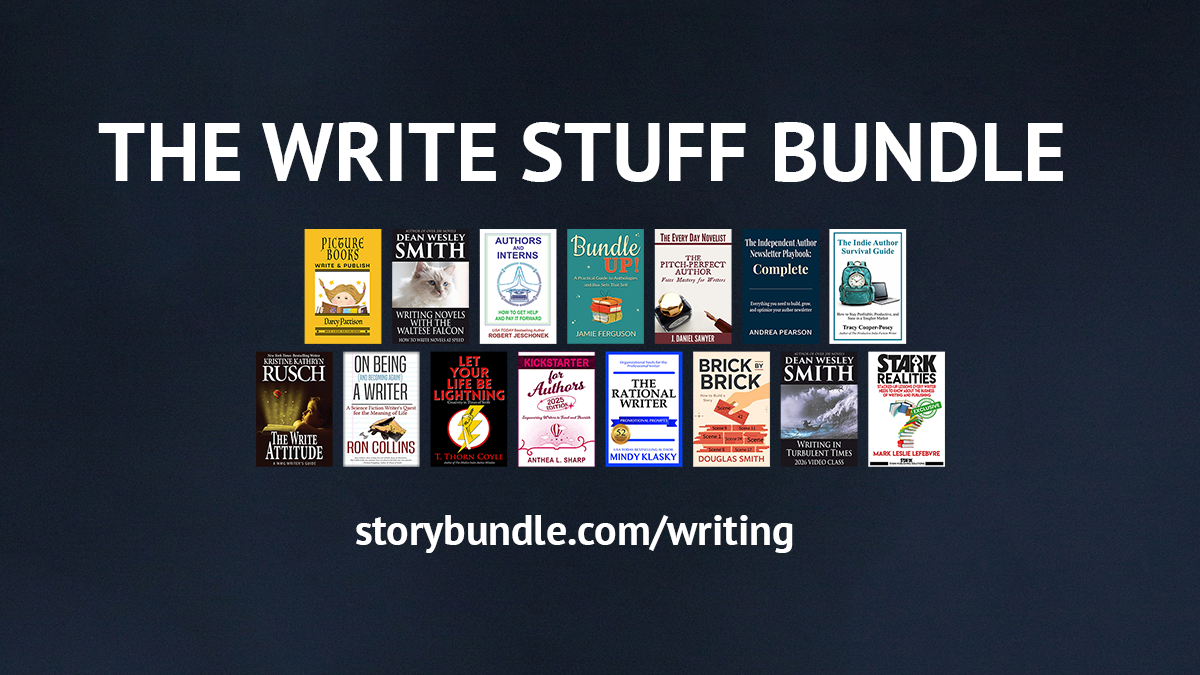
On Being (And Becoming Again!) A Writer is available now in the Write Stuff StoryBundle, curated by Kristine Kathryn Rusch. 15 exclusive books on writing and publishing—pay what you want, starting at $5. Customers can choose to direct a portion of their payment to World Central Kitchen. The bundle runs through May 14, 2026.