
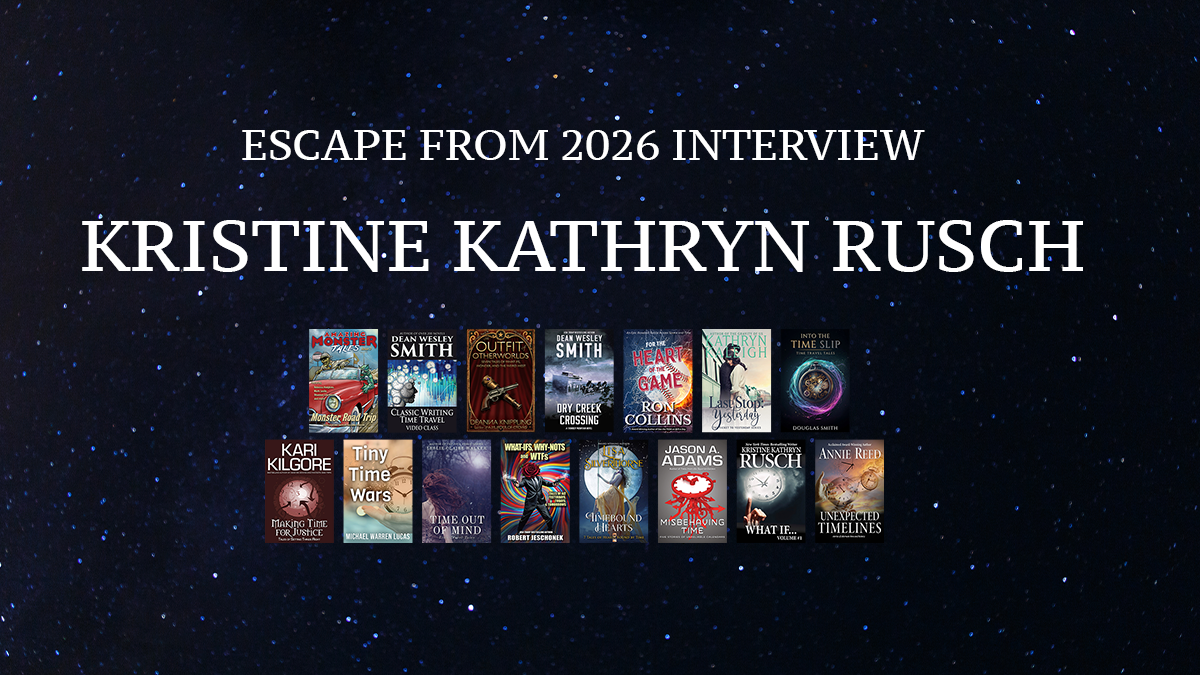
Interview: Kristine Kathryn Rusch on What If… Volume 1

Two of Kristine Kathryn Rusch’s most acclaimed novels share one StoryBundle-exclusive volume. In Snipers, a bestselling crime writer and a detective’s great-grandson use modern forensics to chase the Carnival Sniper, a 1913 Vienna killer as infamous as Jack the Ripper and, like him, never caught. Consecrated Ground—back in print after fifteen years with its original title restored—runs along two timelines, the rise of Nazism in the 1930s and the 1972 Munich Olympics, as an American reporter presses a retired detective about the failure that haunted him. We talked with Kris, who also curated this bundle, about why a place you’ve researched for years can still leave you lost, the detective she insists didn’t fail, and coming back to a book that turned out more relevant than she ever wanted it to be.
The Interview
Consecrated Ground braids two real and terrible moments—the rise of Nazism in the 1930s and the 1972 Munich Olympics—into a single novel. What made you want to tell a crime story across both?
Well, clearly Stecher did not manage to arrest the perpetrator of the crime he’s dealing with. So, what happened? Why didn’t things work? It was best to tell this in flashback, and unfortunately, American journalists were thin on the ground in West Germany. She needed a reason to be there. A lot of journalists were in Munich during the Olympics. I’m sure she didn’t know what was coming—none of us did—so it’s just an echo, but an important one.
There’s a moment at the start of Snipers where your time traveler—who’s read more about 1913 Vienna than almost anyone alive—still gets lost in Ferstel Palace and panics. When you’re building a historical setting, how do you handle the gap between knowing a place from research and actually standing in it yourself?
I used to travel to the sites whenever I could. I learned quickly that what you imagine is not the same as what’s there. Buildings change. Neighborhoods change. There aren’t architectural drawings with old buildings or the buildings got changed in the construction or later construction, so nothing is as it’s billed. Ferstel Palace was badly damaged in World War II, then remodeled. It’s now owned by a private company which, I have to assume, has changed things to fit whatever business they’re running there. So, long story short, it’s easy to get lost in a place that you thought you knew. Even if the time traveler had gone there in his time, it wouldn’t be the same as the 1913 building, maybe by a long stretch.
Both books center on a detective who failed—Runge never caught the Sniper, and Annie tracks down Stecher specifically to ask about his worst failure. In time travel the fantasy is usually that you can go back and change things—so why is the case that never got solved the one you want to write about?
I don’t think Runge failed. He knows who the Sniper is, and what happened. It took forty years for him to understand and get closure, but he did. We readers know even more.
Both books are about the same thing, which is not a failed detective, but an attempt to wipe someone out of history. I wrote Consecrated Ground first because I couldn’t imagine history without that person—and then, somehow, I did imagine history without him in a book I wrote years later.
The bundle’s whole pitch is that people need escape right now—but your contribution includes Consecrated Ground, which you’ve called “sadly relevant” and which looks hard at unchecked power. How do you square handing readers an escape and a much harder read in the same bundle?
Time travel teaches us that we can escape to any place, should the tech exist. But that doesn’t mean that place is better.
That’s the facile answer. The other answer is this: The introduction to the StoryBundle volume warns readers that the second book in the volume, Consecrated Ground, is both noir fiction and is not time travel. Yet the two books are related, which is why they are there.
Snipers is an escape with a touch of romance, so it fits into the bundle perfectly.
Coming back to Consecrated Ground fifteen years later (with the original title restored!), is there anything about the story that you can see now but didn’t realize when you first wrote it?
I wrote the book in 1994. It was published in the United States under that awful title that I won’t use anymore. If you time-traveled to 1994 and told me that Consecrated Ground would be more relevant today than it was when I wrote it, I would be extremely upset. And…you know what…I am upset. We should have learned our lesson from history, but of course, we did not.
You’ve written time travel as mystery, as romance, as SF, as fantasy—you treat it as something that fits almost any kind of story. Does the time travel usually come first, or does a story arrive and time travel turns out to be the way in?
I have no idea. I’m not someone who thinks about writing clinically. I write the story and start with an image. Sometimes it’s a time traveler getting lost in 1913; sometimes it’s a reporter asking an old man questions. Then I go where the story takes me. Sometimes it takes me to time travel. Sometimes it doesn’t.
What are you working on now—and what’s fun or exciting about it?
I’m in a serious mode. I’m writing the second novel in a series under my Kris Nelscott name. It involves three women who are a little ahead of their time, trying to solve problems in a world that doesn’t even recognize women’s issues as problems—which is 1969. What’s fascinating me right now is that the language we use to discuss women’s issues didn’t even exist then. I had to write an author’s note explaining that. It’s why my characters don’t ask focused questions. So much of what was happening to women in those days was Just The Way of The World.
I love these women, though. They’re tough and courageous and very smart, which makes writing about them a blast.
About the Author
Kristine Kathryn Rusch has sold more than 35 million books worldwide. She publishes bestselling science fiction and fantasy, award-winning mysteries, acclaimed mainstream fiction, controversial nonfiction, and the occasional romance. Her novels have made bestseller lists around the world, and her short fiction has appeared in more than twenty best-of-the-year collections. She has won more than twenty-five awards for her fiction, including the Hugo, Le Prix Imaginales, the Asimov’s Readers’ Choice Award, and the Ellery Queen Mystery Magazine Readers’ Choice Award.
Find Kristine Kathryn Rusch

What If… Volume 1 is available now in the Escape from 2026 StoryBundle, curated by Kristine Kathryn Rusch. 15 exclusive books of alternate history and time travel—pay what you want, starting at $5. Customers can choose to direct a portion of their payment to World Central Kitchen. The bundle runs through June 25, 2026.