

Interview: Douglas Smith on Into the Time Slip
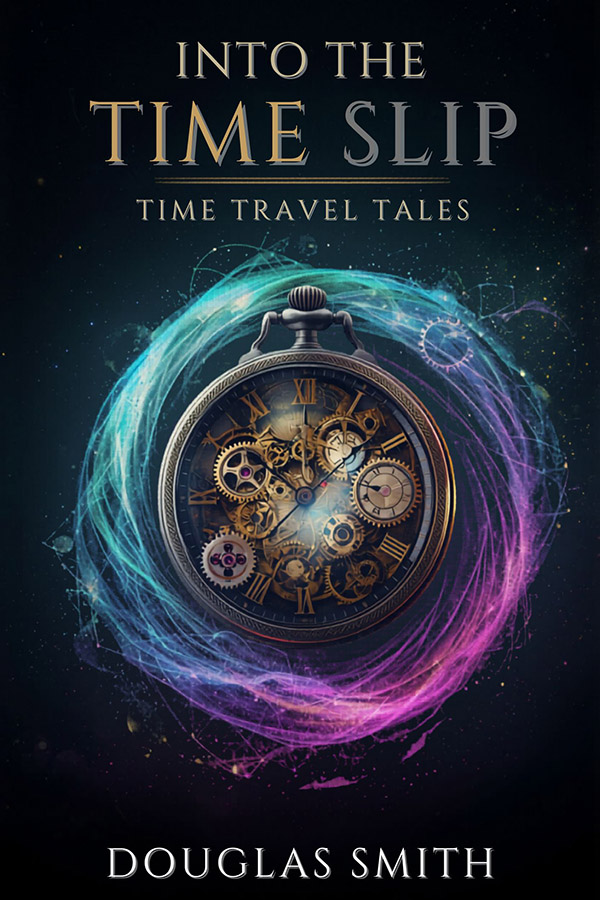
In Into the Time Slip, Douglas Smith grounds each one of his four time travel stories in real science — entropy and Hawking’s arrow of time, remote viewing, a particle collider dragging radio signals out of the past, the branching multiverse — and sends his characters everywhere from a dinner that takes three lifetimes to finish, to a search for lost Van Gogh paintings.
The Interview
Each of the four stories in your collection runs on a different real mechanism—entropy and Hawking’s arrow of time, remote viewing, a particle collider, the branching multiverse. Why does it matter to you that the science actually holds up?
I think it’s more that I don’t like time travel stories that simply use some sort of machine, à la H.G. Wells’ famous story. Many years before I started writing seriously, I wrote a dreadful attempt at what later became “Bouquet of Flowers in a Vase, by Van Gogh” but with a vaguely defined “time machine.” But I never could make it work, probably because I wasn’t yet a writer. After I started writing and selling stories, I kept wanting to return to the story and “do it right” but could never come up with a method of time travel that I liked. One evening, after a session with my writing group, one of the members, who is a Greek scholar and archaeology buff, mentioned a book about an actual expedition to discover the location of the tomb of Alexander the Great, where the team utilized remote viewers to look back into the past. I knew right away that I finally had my method for time travel, a way to look, not for tombs, but for lost paintings by Van Gogh. That was so much fun, I guess, that I’ve taken it as a challenge to figure out more non-machine methods to do time travel.
These stories keep circling loss—people reaching into the past for something they can’t get back. What draws you to characters who can’t stop reaching for what they’ve lost?
I’m not sure I’m drawn to loss. I think it’s more that I think characters need to have pain in their past and/or present for them to be interesting to readers. Characters need to have something to strive for, to remove the pain or recover from it, or to accept that they never will. It just makes for more interesting characters, ones that readers want to follow and root for.
“State of Disorder” is a dinner conversation that takes three lifetimes to finish. You enjoy studying story structure (you go into detail on this in your book Brick by Brick: How to Build a Story). How did you come up with the structure for this particular story, what was tricky, and did you learn anything new while writing it?
That story is probably my favorite from the perspective of structure. The tone I wanted was Poe’s “Cask of Amontillado” and, similar to that tale, I envisaged two men meeting over dinner/drinks. I knew the situation of the antagonist would improve each time he used his messaging into the past, so I’d planned on three dinners. That led to the idea of showing, not the entire three dinners, but one course from each one, naturally progressing to showing the next course with the next dinner. I interleave short scenes from the present time, where the wife of—well, actually the wife of both the protagonist and the antagonist—slowly comes to realize what has happened and what she has lost because of the antagonist’s revenge.
Two of your stories in this collection—“Radio Nowhere” and “If I Should Fall Behind”—are Springsteen songs, and Ziggy signs off with Springsteen the night Liam’s story opens. What is it about Springsteen’s work that has inspired so many of your stories?
I’m a huge fan and have been for years. I’d say the inspiration comes from the simple fact that Springsteen is an astounding storyteller. His strongest songs are ballads, stories told through real characters, everyday people struggling with whatever life has thrown at them. And there is generally such an attitude of defiance and hope despite the odds against them. So many of his songs just speak to me of the bigger stories behind the ones that he just gets to hint at in just a few lines. I have more stories that I want to write based on or inspired by his songs, and someday I’d love to put out a collection of all my Springsteen-inspired stories. My dream would be to get his endorsement, include some lyrics of the songs to intro each story, and have all the proceeds go to his favourite charity. It’ll probably never happen, but I’ll keep writing the stories (because I’d do that anyway).
In “Bouquet of Flowers in a Vase, by Van Gogh” you wrote about a mysterious (and real) painting by your favorite artist. What was your favorite part about writing this story?
I talked about using remote viewing for this story in my answer to an earlier question. I loved learning about how remote viewing supposedly works in real life, then applying that to searching for artifacts in the past. And I really loved selecting specific Van Gogh paintings that reflected the setting and actions in the following scene.
Library Journal calls you one of Canada’s most original SF writers, and Kris puts your place in Canadian SF right up front. Is there something specifically Canadian in how you write the fantastic, or do you feel this is more of a community you belong to than something a reader would find on the page?
I think it’s more the former. Beyond the Canadian and Toronto settings in many of my stories, one of the themes that recurs in my work, especially my Heroka shapeshifter stories, is that of the conflict between our civilization and the natural wilderness, as our resource-based industries, which feed our cities’ growing hunger for timber, water, power, minerals, and land, consume more and more of the natural world and habitats of our wildlife. Our country has always been defined by its vast wilderness areas, and yet the huge majority of our population lives in only a few highly urbanized pockets of that vastness. So there’s this destructive dichotomy between us and the land we live in—we live off of the land but we don’t really live in it. But for those who do live there, and for the wildlife species that live there, we’re destroying more of that wilderness every year to feed the hunger of the cities. This is the central theme in The Wolf at the End of the World and in most of my other Heroka stories. The Heroka are a race of shapeshifters whose vitality as a race is tied directly to the vitality of their totem animal species—species that are dwindling as their natural habitats are destroyed by logging or mining concerns, or flooded for hydro-electric projects.
Other Canadian themes in my work include a suspicion of both corporate and political power, a suspicion that I think is greater here in Canada than, for example, in the US.
What are you working on now—and what’s fun or exciting about it?
I’m working on a post-apocalyptic SF novel that is a sequel of sorts to many of my short stories set in what I call the Merged Corporate Entity universe, where a plague-ravaged Earth is ruled by a single corporation. It’s a lot of fun pulling the characters and story lines from different tales into a single novel, and fun to see what these characters have become.
About the Author
Douglas Smith is a five-time award-winning author described by Library Journal as “one of Canada’s most original writers of speculative fiction.”
His work includes the multi-award-winning urban fantasy trilogy The Dream Rider Saga (The Hollow Boys, The Crystal Key, The Lost Expedition); the urban fantasy novel The Wolf at the End of the World; the collections Chimerascope, Impossibilia, La Danse des Esprits (translated), and Borderlanz; and the writer’s guides Playing the Short Game: How to Market & Sell Short Fiction and Brick by Brick: How to Build a Story.
His short fiction has appeared in the top markets in the field, including The Magazine of Fantasy & Science Fiction, Amazing Stories, InterZone, Weird Tales, Baen’s Universe, Escape Pod, The Mammoth Book of Best New Horror, The Year’s Best Canadian Fantasy & SF, On Spec, and Cicada.
Find Douglas Smith
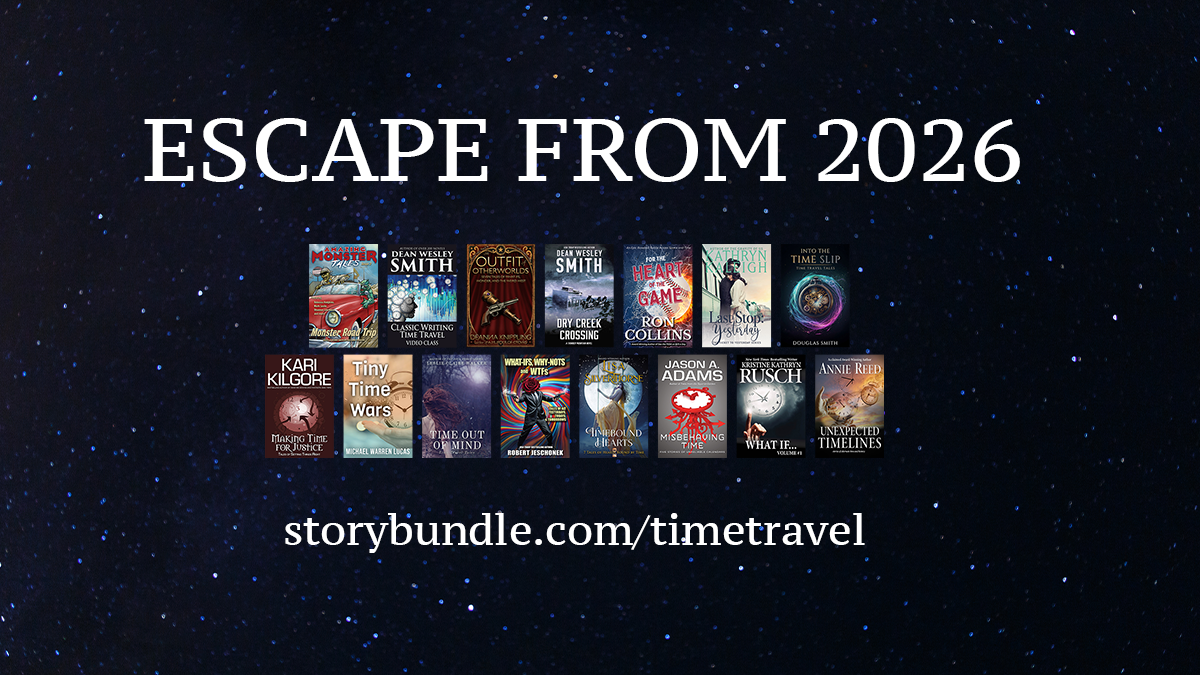
Into the Time Slip is available now in the Escape from 2026 StoryBundle, curated by Kristine Kathryn Rusch. 15 exclusive books of alternate history and time travel—pay what you want, starting at $5. Customers can choose to direct a portion of their payment to World Central Kitchen. The bundle runs through June 25, 2026.