

Interview: Michael Warren Lucas on Tiny Time Wars

In Michael Warren Lucas’s hands, time travel is rarely the point. Across the five stories in Tiny Time Wars, it’s a lens on the people caught up in it — a teenager handed a do-over, a man who builds a time machine and promptly argues himself out of using it, a guy in supernatural witness protection up against the almighty power of last year’s taco shop. The stakes swing from world-changing to deeply petty, often in the same breath, but Lucas cares less about the paradoxes than about the people tangled in them.
The Interview
Kris says you’ve forgotten more about science and tech than she’s ever learned. 🙂 When you’re coming up with a time-travel premise, how far does the physics have to hold up before you’ll let yourself break it?
Here’s the thing. Physics says time travel is not possible, so I’m going to ignore your question and talk about singularities. (Dear actual physicists, I beg your forgiveness for this explanation. The truth is far more complex and intricate and glorious than my words can convey.)
In physics, the best-known singularities are black holes. They swallow everything! Nothing ever leaves! We can’t imagine conditions within them!
Technically, though, that singularity isn’t where the universe ends.
It’s where the theory’s math breaks. We divide by zero and everything collapses.
Our current theories of physics are basically a pile of math. We have classic Newtonian physics formulas like F=ma and v=at. This math all works. We use that math to build ships and houses. If the math didn’t work, cars wouldn’t work. But that math has limits. We can see the moon. It’s right there. But you can’t get there using Newtonian physics.
Under some conditions, the math breaks. When Isaac Newton’s math didn’t explain the movement of the planets, that was a singularity. Resolving that singularity required new math, special and general relativity. Once you figure out E=mc² and all its buddies, you can actually reach the moon. Plus we get previously unimaginable blessings (microwave ovens, cellphones, cable TV) and curses (nuclear weapons, the Internet).
Black holes, as well as other puzzles like cosmic expansion, show that our current theories have limits.
Using Newtonian physics we could see the moon, but couldn’t touch it—until we could.
Using relativity we know the past exists, but we can’t touch it.
Whoever figures out the divide-by-zero error we call “black holes” will open the door to whatever great advances lie beyond microwave ovens. I have no idea what they are.
So how plausible does the physics have to be before I allow a time machine in a story? Pfffft! waves hands It’s a singularity, let’s GO!
One story pits a guy in supernatural Witness Protection against “the almighty power of last year’s Taco Shop.” Is this based on a real taco shop?
Delta, Utah. The sign literally says Taco Shop.
Nobody can resist the Taco Shop.
If a gang of abuelas decided to conquer the world and fix all our bullshit, we could not stop them. Sadly, they’re more interested in feeding us. (I’ve suggested feeding us after they conquer us, but no.)
“Disrupting time to kill Hitler? Meh.” A whole lot of time travel fiction treats that type of thing as the obvious move. What made you wave it off and point the time machine at one person instead of all of history?
Let me be very clear: Hitler was bad. If you breach a singularity and find yourself in possession of a time machine, you have an overriding moral duty to kill Hitler. People have written great stories about folks who went back in time to kill Hitler, though. I have no unique passion or insight about history’s second-greatest monster. (Greatest? King Leopold of Belgium, who killed 10–15 million in the Congo. While you’re at it, take him out too. There’s probably more, but let’s stay on Hitler.)
The problem is, Hitler isn’t the problem. Hitler was a symptom. Hitler was an awful seed that found fertile soil in resentment, starvation, and structural failure. People welcomed his message. We see Mein Kampf. We don’t see the many late-night discussions over a drink that fed writing it. If German society hadn’t been such a mess, Hitler would have been a little man ranting on a street corner.
Kill Hitler, someone takes his place. The details might play out differently. Perhaps we would avoid the Holocaust. But a failed society will implode, somehow.
I grew up in the Reagan era. I remember how people reacted to Reagan. Blaming Reagan is popular. My latest novel, Laserblasted, doesn’t mention Reagan by name, but could be summed up as “Reagan was not the problem. He was a symptom.” The same dynamic plays out today.
For storytelling, the soil interests me more than the seed.
You’ve got orcs sitting in an American classroom learning their letters, which might be the least orc-like thing an orc could be doing. You write a lot of orcs—what is it that you like so much about them?
Because I am an orc.
I’m a big man. You build a world out of delicate materials like glass and steel and concrete, then get mad at me for breaking things? Why do you set me up for failure?
I’m neuroatypical, so I’m normal. Y’all are a bunch of crazies. Why—WHY—are you doing these things? Can’t you see the harm you’re doing to yourselves, if not to me?
But no. You make me wear shoes and sit in meetings when I could be working the actual problem you’re paying me to handle. You allow a rentier class to hoard resources when you could just do away with them. You do this “flirting” thing and expect romantic partners to read your mind instead of declaring “I think you’re great, what if I gathered my clan and raided your home to show my worth to your family as I capture you? If I displease you afterwards, at any time, cut my throat?”
See? Simple. Sensible. Clear. Why are you so complicated?
One of your characters will risk everything to switch his time machine on; another invents one and immediately browbeats himself out of it. What do you find so compelling about the decision about whether to use the thing at all?
Time travel stories aren’t about the time travel.
The characters in both these stories are smart. I know many smart people. Smart people are some of the stupidest people you will ever meet. Intelligence is important, but so are empathy and love and all the things that connect us as people. I know many wonderful smart people who have all these traits and leverage them to care for themselves, their families, and the greater community. People who have brains but lack empathy, who don’t understand that their skills can’t solve everything and they need a community composed of people not like them, are failed human beings.
Time travel is an interesting way to highlight that.
Do you think of time travel as a way out of a reality, or a way to keep arguing with one?
Neither. I think of time travel as a way to highlight cracks in people’s psyches, and will merrily adjust the rules of time travel to make things worse for my poor characters.
What are you working on now—and what’s fun or exciting about it?
Wearing my fiction hat: I’m finishing up a six-book future fantasy epic. That won’t be released until the whole thing is finished. I’m hoping to launch my Christmas collection, Twisted Presents, in a couple of months, so folks can get a copy in their hands before the holidays.
Wearing my nonfiction hat, I’m writing a book about filesystems. Because the hard part in computer management is avoiding losing data yet again.
About the Author
Michael Warren Lucas has published over fifty books, despite society’s best efforts to stop him. His other novels include Immortal Clay, Drinking Heavy Water, the Prohibition Orcs historical fantasies, and the 80s SF satire Laserblasted.
Find Michael
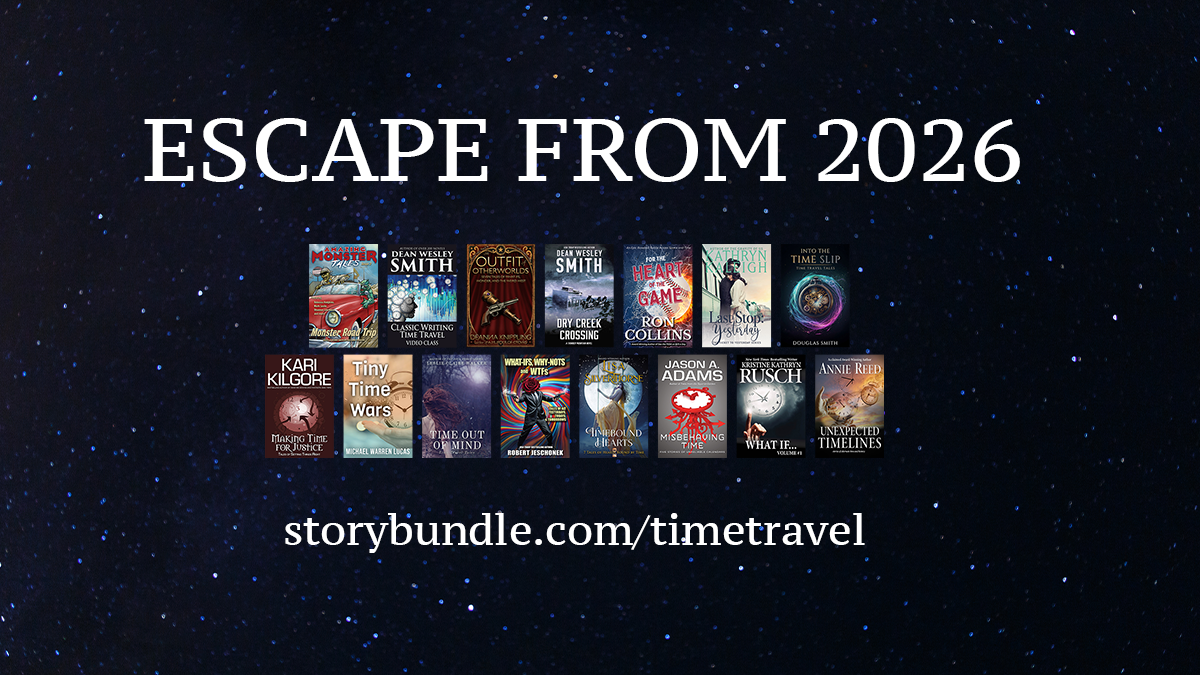
Tiny Time Wars is available now in the Escape from 2026 StoryBundle, curated by Kristine Kathryn Rusch. 15 exclusive books of alternate history and time travel—pay what you want, starting at $5. Customers can choose to direct a portion of their payment to World Central Kitchen. The bundle runs through June 25, 2026.