
Interview: Inside Monster Road Trip — Mark Leslie, DeAnna Knippling & Jamie Ferguson
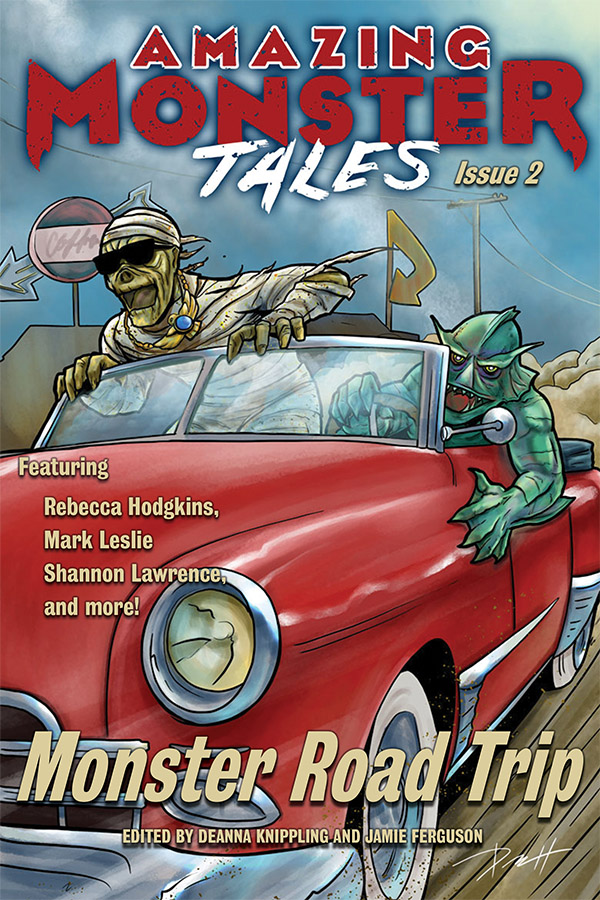
Amazing Monster Tales: Monster Road Trip packs ten monsters into cars, trains, and trouble—and we pulled three of its contributors aside to talk about the rides they wrote. Mark Leslie sends his Canadian werewolf across the country by train; DeAnna Knippling drops a 1957 zombie-plague comet on the Nevada desert; and Jamie Ferguson straps two goblins into a cross-country road trip so one of them can propose to the girlfriend who left him. We asked each of them two questions about their story—and then put the same two to all three.
Mark Leslie—“Stowe Away”
Michael isn’t just a werewolf—he’s a bestselling novelist who runs his life the way he writes: a rough plan, and faith he’ll figure out the rest as he goes. Is that how you work, too?
Mostly, yes. There are only two books in the currently eight titles in the Canadian Werewolf series that used any sort of structure or outline. And the only reason for that was because they were the ones I co-authored with Julie Strauss. Lover’s Moon was the romantic comedy “backstory” meet-cute (or meat-cute as some readers of the series joked about) about Michael and Gail, who used to be a couple, and Hex and the City was another tale that returned to the humorous urban fantasy adventure where both Michael and Gail’s POVs were toggled between. All the other books are mostly told through Michael’s first person POV. I needed my good friend Julie Strauss to write Gail’s POV for a few reasons. First, I was unable to see Gail’s flaws because I saw her too much from Michael’s perspective. And he idolizes her. Two, I needed help writing a shorter novel in the series that followed a proper romance structure. And three, Julie’s a brilliant writer who really knows her way around humor. She knocked it out of the park. But, of course, when we co-authored alternating chapters, we really needed to know what happens in each chapter. So we used Plottr to draft out the main beats for the overall story, the chapter-by-chapter “this is what happens here” story beats.
Speaking of not planning, nothing about the Canadian Werewolf series was planned. Not even the first novel. It was derived from a short story I’d written where a mentor of mine who’d read it prompted me by asking, “So what happens next that day?” That story evolved into a novel that I thought was going to be a stand-alone. At least I thought so until a pair of editors asked if I’d be interested in writing a story for their “Monster Road Trip” themed anthology. And I couldn’t help but wonder what might happen if my werewolf was stuck on a train between New York City and Stowe, Vermont and was going to change into a wolf before the train arrived at its final destination. That became the story (and later, the novella, “Stowe Away”). And that prompted me to want to explore further adventures of Michael.
Michael might be the least threatening werewolf in fiction—he helps strangers, cracks self-deprecating jokes, and worries more about embarrassing himself than about the moon. What do you enjoy about writing a monster readers can love?
Michael was initially borrowed from a combination of me stealing elements of my own life and thoughts and experience with wanting to pay homage to the character of Peter Parker from the Spider-Man comic books I grew up reading. His very first adventure was basically me asking a practical question of what would I do if I lived in a major city like New York and suffered from a werewolf curse. Where would I go for the inevitable full moon change to run around on all fours? Where would I stash my clothes for the next day? How would I deal with the black-out periods where I didn’t know what I’d done the night before? And what would happen if I woke up on the far side of the city without any clothes? I tried to answer that in how Michael responds. That aspect of Michael was easy.
As the stories continued I continued to draw elements from my own life and Peter Parker’s, but also adapt other literary figures and stories that compelled me. Monsters have constantly been misunderstood. I love Shelley’s original (and very pre-Boris Karloff/Hollywood era) exploration of Frankenstein’s monster. That’s something I’ve leveraged in a few different shorter pieces I’ve written. I also like exploring perception. We see monsters in the things and people we don’t understand. And we can often not understand parts of ourselves, too. Michael has no idea what his wolf-self gets up to. And the point isn’t the wolf, it’s how the man deals with the side effect. And how the man leverages the additional heightened senses and powers he didn’t ask for.
In a review of the first novel, someone described Michael as “the thinking man’s werewolf.” What I like most about that, and similar reviews, is that people enjoy a new/different take on the werewolf mythology. I even doubled-down on the alpha wolf/beta human concept when shifter romance with overtly masculine men became more and more popular. I wanted Michael to be flawed, and to recognize his flaws. I wanted him to make mistakes, screw things up, misinterpret things DESPITE having better sensory perception than most other people around him. And I know, because I’m chock-full of flaws, that he’d have to have a hearty sense of self-deprecating humor just to be able to survive. I love writing about Michael. And I’m very lucky that there are readers who really love reading about him.
DeAnna Knippling—“The Plague Comet”
Joe and Mack are crooks and they know it—but when it matters they do the decent thing, no fuss, no redemption arc. When the world’s ending, what does decency actually buy a person?
I took the opposite angle on this: when the world’s ending, what costs to being decent are removed? When you no longer fear death (because you’re pretty sure you’re going to die anyway), what instincts to help others get to be released? A fun experiment.
A zombie apocalypse is usually the whole show—here it’s barely the half of it, with something worse waiting in the desert. What do you think most people get wrong about the end of the world?
I think we’ve kind of collectively figured out that preying on each other is a bad overall strategy after a social collapse. People still do, in real life. But that idea has been thoroughly explored in fiction. Here, I wanted to show that the end of the world had its roots in the sort of everyday exploitation that we’ve allowed ourselves to overlook, that overlooking that exploitation in the first place was what got us screwed. I dunno if that came across, but that’s what I was playing with.
What I think most people used to get wrong about the end of the world is that the worst part isn’t dying, it’s trying to survive afterwards. Now that we’ve had a taste of COVID-19, though, I’m gonna say that we’re learning how to process the idea that the end of the world is just the beginning of the hard part.
Jamie Ferguson—“Goblin Road Trip”
Heinrich is a lot. He wears Christmas slippers in June, can’t read a map, is terrified of driving under overpasses—which is a bit of a complication on a cross-country road trip. He should be exhausting, and certainly is to his cousin Bean. So why is he so easy to love?
I love Heinrich. My original idea was to send Bean on a cross-country trip with an annoying companion. I had no idea Heinrich would have all of the foibles he has, but once I started writing this story things just kept coming up. I could have written Heinrich differently—he could have been genuinely annoying to the reader. But after I wrote the first scene, where Bean and Heinrich embarked on their road trip but have already gone back to Heinrich’s apartment three times to get things Heinrich forgot, the dynamic had changed. It wasn’t just that Heinrich was annoying to Bean (which he was), he’d also changed from “annoying cousin passenger” to feeling like a real character in the story. That’s part of what I love about writing. Sometimes I start writing an idea, but it takes a while until the characters feel alive. I usually feel like I know the character(s) I’m writing about when I’m about a thousand words into a story. Every once in a while things go differently, and with “Goblin Road Trip,” I knew Heinrich by the time I’d written the second page.
Bean’s a goblin living in disguise among humans, and under the comedy there are elements of sadness and loneliness. He has to hide a core part of who he is and leave the goblin caverns for good in order to pursue his dreams. Why did you put so much on the poor guy?
Years ago I read a series of books my first mother-in-law (a great lady who’s no longer with us, and I’m still very good friends with my ex) recommended. The books were well-written, except for one key thing. After I’d read enough of the series, I knew that every book would end up with the heroine accomplishing everything no matter what the odds were. I read the first book thinking she might fail and have to overcome obstacles, but even when that happened she triumphed very strongly and very quickly. I eventually got bored—what’s the point of reading about strife if you know it’s going to be resolved easily?
In “Goblin Road Trip” Bean’s goal is to get his cousin Heinrich from Pittsburgh to Colorado. The stakes aren’t as high as in the series I mentioned, and I could have easily focused this story on the two cousins alone. But learning more about Bean gives him depth. He’s not just some guy driving his cousin across the country, trying to avoid overpasses along the way because Heinrich is terrified of them. He’s a guy who’s dealing with being a goblin passing as human, and he’s afraid to pursue romance because he doesn’t want to be deceptive about his heritage—plus if he reveals his goblin nature to anyone he might get exposed and have to give up on his dream of being a wind engineer. All of this makes Bean feel more real, and makes the reader (hopefully) care about him. It certainly makes me care more about him. I’ve written 3 stories about Bean now, and I’d love to write even more.
And, asked of all three…
What was your favorite part of writing your story?
Mark: My favorite part of writing this story—apart from the fact it was the premise y’all had asked for that sparked something none of us could have predicted (okay, maybe you and DeAnna predicted it, because I remember you responding to my idea for a story to write that you were sure it’d be way longer, likely closer to 20,000 words than the 5,000 to 8,000 words I claimed I’d stick to)—was discovering the character of Bridget Wells, or “Bridge” as her good friends call her.
Bridget was initially crafted as a trope-type character. I needed to have someone on the train who needed protecting. Someone Michael could get distracted by needing to look after on his way to his goal of needing to be in Stowe, Vermont for a friend who needed him. She was a “victim” character, a young woman being stalked by a human predator, and I liked the idea of a half-man/half-wolf “predator” protecting a human from a fellow human predator.
But then Bridget opened her mouth when Michael first bumps into her on the train. Remember, I don’t outline. All I knew was the premise I was writing, and I started to populate it with the people who’d fill the various needs as they arrived. But the first thing Bridget says to Michael took me by complete surprise. And suddenly, she started speaking in a very animated fashion, and I was curious to know more about her. And once Michael and Bridget started talking, and when she became Bridge to both me and Michael, I realized that this character was making space for herself. She wasn’t a victim, she was strong, independent, brilliantly smart, and craftily perceptive. She would be a mentor figure to Michael in the same way he was a bit of a mentor to her. I’ve had a handful of readers continue to ask me when Bridge might be returning to the storyline, and I’m happy to share that I’m thrilled to be bringing her back in book nine of the series, when Michael returns to his old stomping grounds in Canada in A Canadian Werewolf in London, Ontario.
DeAnna: Hm…the research. I knew where I wanted them to drive, I just had no idea what they’d run into on the road. I was going over the route on Google Maps and found something on the map…the place they discover is based on a real, failed religious/health spa out in the desert at a place named Zzyzx. So the second half of the story was mostly a surprise to yours truly.
Jamie: Writing the interaction between Heinrich and Bean. That was super fun, so much so that I’ve written another story involving the two of them, and will likely write more over time. It’s really fun to write about Heinrich from Bean’s perspective. It just occurred to me that I’ve never thought about writing a story with both of them from Heinrich’s perspective. I’m going to give that some thought.
And the most important question of all—what’s the worst possible monster to be stuck in a car with?
Mark: Oh gee, that’s such a fun question. So many possibilities. A were-stink-bug? I think that perhaps because there’s nothing like being stuck in a vehicle where you’re trapped with someone’s bodily functional odors. Again, I try to go with the logistical elements. I mean a ghost driver would be the worst, particularly if they couldn’t consistently affect physical objects and occasionally the car just veers out of control.
Oh no, wait, I have it. And I’m sure that most people who’ve been stuck with one of these in a car when they were younger might agree. The worst possible monster to be stuck in a car with is a dad who spouts off the stupidest eye-roll-inducing puns and dad jokes, sharing things he’s said a hundred times and yet laughs heartily at them as if it’s the first time they’d ever be heard. The person who, out of nowhere exclaims “HAY!!!” in the loudest possible voice, scaring the bejesus out of everyone in the car while pointing out at a bale of hay in a farmer’s field. Oh no, wait, that’s me. That’s me I’m talking about. I’m the worst possible monster to be stuck in a car with.
DeAnna: Assuming it doesn’t eat you right away, one you’re allergic to.
Jamie: Probably any monster, except for Bean and Heinrich. My only concern about being in a car with them is that if Bean were driving (Heinrich doesn’t know how to drive, which is good because he’d be terrible at it) the two of them might get in an argument at an inopportune time and that could end badly. In fact, if I were in a car with both of them the best option would be to make them sit in the back seat.
About the Contributors
- Mark Leslie writes the Canadian Werewolf series along with horror and humorous urban fantasy; his dark fiction is often compared to Twilight Zone or Black Mirror. markleslie.ca
- DeAnna Knippling writes atmospheric gothic horror, mystery, suspense, and twisted tales from the edge of space & time. wonderlandpress.com
- Jamie Ferguson writes stories where magic lives just beneath the surface—folklore, emotional depth, and characters navigating impossible choices. jamieferguson.com
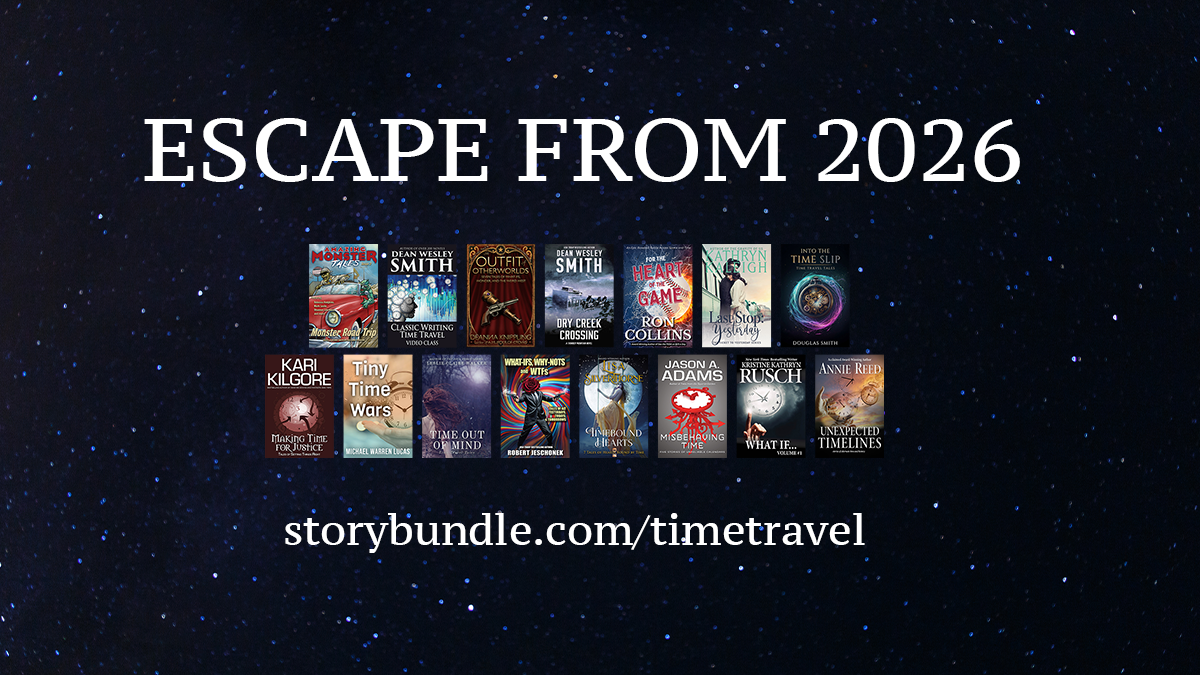
Amazing Monster Tales: Monster Road Trip is available now in the Escape from 2026 StoryBundle, curated by Kristine Kathryn Rusch. 15 exclusive books of alternate history and time travel—pay what you want, starting at $5. Customers can choose to direct a portion of their payment to World Central Kitchen. The bundle runs through June 25, 2026.