
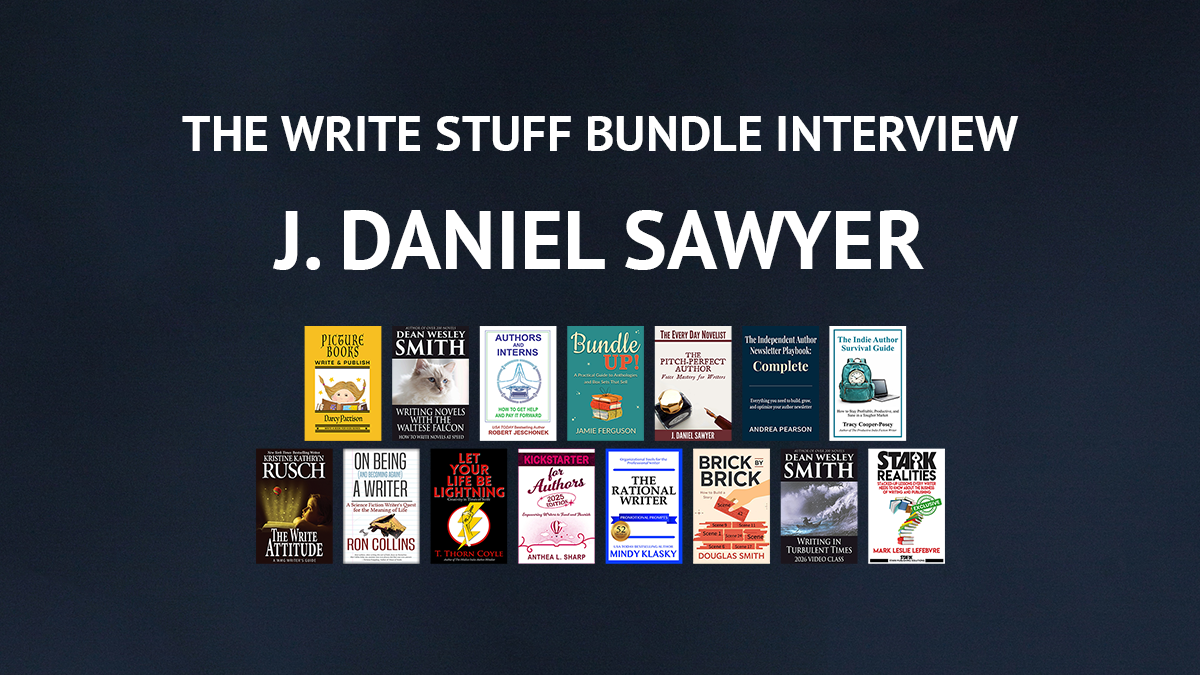
Interview: J. Daniel Sawyer on The Pitch-Perfect Author

J. Daniel Sawyer has spent over forty years studying how language and sound affect human psychology—starting with his first choir and his first radio drama, and continuing through a career that’s produced over thirty books and nearly a dozen podcasts. He writes from a private forest in a rural exile, which sounds about right for someone who thinks this deeply about words.
His contribution to the Write Stuff StoryBundle is The Pitch-Perfect Author: Voice Mastery for Writers—a book about the difference between a good writer and a great one. That difference, Dan argues, is voice. Drawing on physiology, linguistics, vocal performance, and musicality, he shows writers how to recognize the tools they’re already using and sharpen them on purpose.
The Interview
What is author voice, and why would an author want to work on developing their voice?
The author’s “voice” boils down to three things: 1) The way you use language 2) the themes in your fiction, and 3) your story structure. Those things together create a completely unique gestalt that mark your writing out from everyone else’s writing. However, most of the distinctive qualities of your voice—these are all bound up in the way you use language—are the things that most writers are tempted to massage down and polish away through the process of revision. Just like hearing your voice on a recording, reading your voice in writing sounds boring to you, and kind of hokey, because it’s a pale imitation of the voice you hear in your head all the time—it’s ordinary, but anemic.
The opposite of the error of grinding your voice away is learning to hear its unique qualities so you can develop it and master it like an opera singer masters her voice. Learning to use words to intensify your style and deepen your relationship with your audience through your fiction is the key advanced skill for any writer who wishes to make the transition from “My stuff is reliably professional, readable, and enjoyable” to “My books are becoming heirlooms.”
You define meta-audition as “the ability to notice and attend to your subconscious reactions to the flow of words.” How can an author learn to do this objectively with their own work?
The two most accessible and legal methods (i.e. those that do not include massive drug use combined with long years of meditation in pursuit of self-emptying) are
1) Listen to your audiobooks until you get sick of them, then keep listening to them until you suddenly fall in love with them again. Comedians call this technique “crossing the line twice.” When you hit that “I’m sick of this” break point, your mind (for fascinating neurological reasons) starts engaging with the material as if it is completely strange and has nothing whatsoever to do with you. When you hit the “I like it again” part, that’s your mind solidifying a new relationship with the material. This kind of deliberate psychotic break lets you hear the words as written instead of hearing the words as intended—and, once you learn to do that, you can turn the skill on-and-off at will.
2) Read your books out loud, a lot. Constantly, at least as you write them. This pushes your words into your audio system and forces you to listen to them (it has the added advantage of forcing you to feel the shape of the words in your mouth).
As you take either of these approaches, pay attention to when you wince, or get a big hit of pleasure, at a word or turn of phrase. This reaction is a musical one—it’s the same reaction you have to hearing a wrong note (in the former case) or a note you’ve been set up to anticipate. Then, like a musician, correct those wrong notes (if you’re editing) or pay attention for the feel of them in the future as you write, and steer around them. That sensation of “wrong note” tells you “this isn’t a natural part of this story/my voice.”
Why is it a good idea for an author to have a command of both connotation and denotation for every period they write in?
Denotation is what a word actually means. Connotation is what it implies. It’s one thing to hit a drum. It’s a whole other thing to bang on bongos. Even though both phrases literally mean the same thing, the connotations (through proximity to slang usage) of “bang” and “bongo” give the phrase a bawdier, more physically rich feel (and the alliteration also adds a sense of play).
Connotation, in common speech, often supersedes denotation, so getting it wrong not only can create a lot of mischief, it will also rob your work of period-accurate flavor (and the flavor of your language is the most powerful tool you have where worldbuilding and scene setting are concerned). If that flavor is consistent, your verisimilitude problems are 90% solved, and your audience will follow you to places where they wouldn’t follow someone who (for example) had factually perfect historical worldbuilding but narrated with a voice that sounded like it came from last week’s viral TikTok. A period-and-locality-appropriate voice, on the other hand, lets you weave an illusion that will win trust from your audience.
The Pitch-Perfect Author is a fascinating book. What did you most enjoy about writing it?
I’ve been studying the way language and sound affect human psychology for over forty years (i.e. since the year I joined my first choir and produced my first radio drama). When you live and breathe something like that, you lose track of what it is you’ve really learned. Writing this was a fun review of everything I’ve learned in that time, and helped me sharpen my own voice skills again. But more than that, the further I got into the book, the more excited I became that other writers would be able to use everything I’ve learned to up their game. Writers who are good with voice are very rare indeed, and (predictably) it’s the single quality I most gravitate to as a reader. Be the change you want to see, right?
What’s an example of one of your “chops” (writer’s ticks), and how would an author learn what their own are?
I love an ironic turn of phrase that employs a non-obvious pun. One that I’ve caught myself using several times over the years is “Bob was as good as his word, and a hell of a lot better than his English/speech/diction/etc.” In that one little sentence, we’ve got 1) admiration of a character, sardonic delight, and a backhanded insult that gives you a feel for how others perceive Bob’s patterns of speech. That’s one of a few dozen of mine that I’ve identified well enough that I can use them deliberately to influence the audience experience.
To find your own, read your work. No matter how much you hate it, read your work. What are the stock phrases, rhetorical techniques, and adjectives that you lean on most? Chances are that, at least early on, you’re overdoing it—but if, instead of eliminating them, you notice why you’re using them, you can deploy them for maximum punch in a way that makes the reader think “Oh yeah, I’m reading a book by X. Nobody else would say it like that.”
Your voice is what they’re buying your books for. Give ’em what they want 😉
Why is it important as an author to stay focused on what the narrator wants?
Whether you’re working in first person or third person (or you’re daring enough to work in second person), your readers experience your narrator as a character. Understanding what your narrator’s objectives are in telling the story, what his/her attitudes are about the events and emotions in the story, etc. helps you deliver a consistent, seamless experience for the character—and all this is true even if the narrator really is just you.
When you tell a story, you’re not conveying information. You’re creating an experience. Don’t confuse the two.
What are you working on now—and what’s fun or exciting about it?
I am writing the tenth and final installment in my series The Clarke Lantham Mysteries and putting the finishing touches on a new YA science fiction adventure set on a half-terraformed Venus. In both cases, I’m getting deep into how technological change re-makes the grounds for human relationships, and exploring the struggles people have working out new customs and ethics in light of old values on the ground forged by a technological landscape that changes how we understand our humanity.
It’s a topic that’s much on my mind here at the beginning of the AI and the Biotech revolutions, and the best way I know how to think such things out for myself is through telling stories.
That, and crazy adventures on the fringes are always a rollicking good time 🙂
About the Author
After a childhood in academia, J. Daniel Sawyer declared his independence by dropping out of high school and setting off on a series of adventures in the bowels of the film industry, the venture capital culture of silicon valley, surfing safaris, bohemians, burners, historians, theologians, adventurers, climbers, drug dealers, gangbangers, and inventors before his past finally caught up to him.
Trapped in a world bookended by one wall falling in Berlin and other walls going up around suburbia and along national borders throughout the world, he rediscovered his deep love of history and, with it, an obsession with predicting the future as it grew aggressively out of the past.
To date, this obsession has yielded over thirty books and innumerable short stories, the occasional short film, nearly a dozen podcasts stretching over a decade and a half, and a career creating novels and audiobooks exploring the world through the lens of his own peculiar madness, in the depths of his own private forest in a rural exile, where he uses the quiet to write, walk on the beach, and manage a production company that brings innovative stories to the ears of audiences across the world.
Find Dan
- jdsawyer.net
- Substack (weekly essays on history, art/culture, and DIY)
- Latest novel: announcement and sample
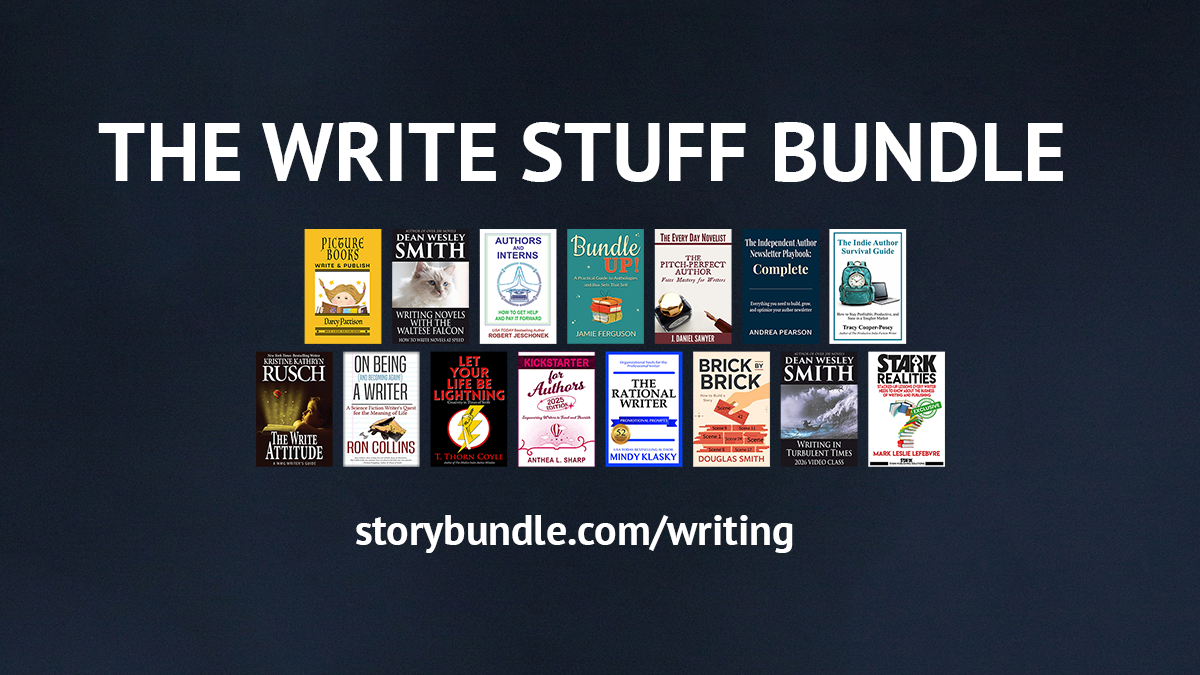
The Pitch-Perfect Author: Voice Mastery for Writers is available now in the Write Stuff StoryBundle, curated by Kristine Kathryn Rusch. 15 exclusive books on writing and publishing—pay what you want, starting at $5. Customers can choose to direct a portion of their payment to World Central Kitchen. The bundle runs through May 14, 2026.