
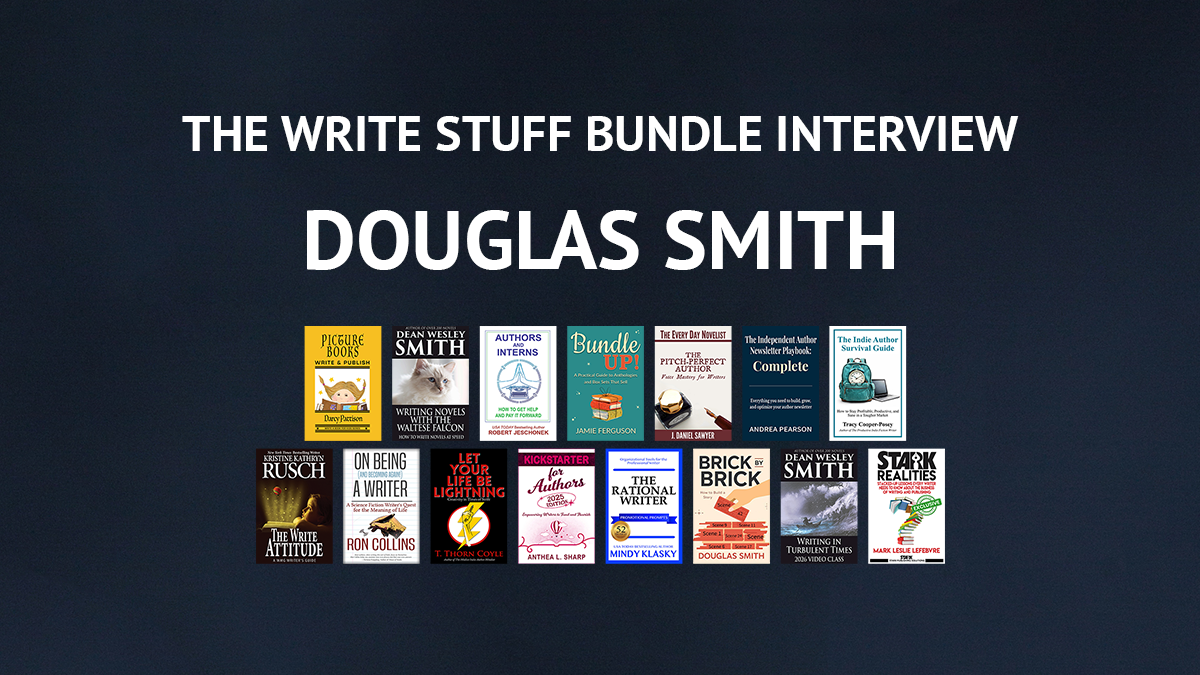
Interview: Douglas Smith on Brick by Brick: How to Build a Story

Douglas Smith is a five-time award-winning author described by Library Journal as “one of Canada’s most original writers of speculative fiction.” He’s published in 28 languages, won Canada’s Aurora Award four times, and written everything from urban fantasy novels to short fiction for the top markets in the field.
His contribution to the Write Stuff StoryBundle is Brick by Brick: How to Build a Story—a craft book that takes a different approach from most. Where other books hand you the tools, Doug teaches you how to design the house. It’s about story structure: how to build scenes, sequence them, choose points of view, and handle transitions. If you’ve ever had a story idea but weren’t sure how to turn it into a complete, well-structured tale, this is the book for that.
The Interview
Most craft books focus on providing the tools an author needs, as opposed to Brick by Brick’s approach on teaching how to create story structure. Your analogy is this is like giving someone the tools to build a house instead of teaching them how to design a house. Why do you think it’s so important to focus on structure?
Yeah, I take an alternative approach to what most craft books provide. My theory is that most craft courses or texts are great at focusing on some specific tool a writer needs in their toolbox, but none help a writer step back and create a blueprint for what their story or book will look like. Brick by Brick helps a writer build the structure for their tale, using scenes as the building blocks for that structure, or the bricks if you will. It teaches you how to create a list of scenes in your story, how to sequence them, choose POVs for each scene, and most importantly, how to transition from one scene to the next handling switches in the timeline or POV.
Why is asking questions such an important part in developing a story idea?
A story idea will rarely appear fully formed in a writer’s head. If it does, lucky you. For most of us, we’ll get the initial kernel of an idea, and we then need to develop that seed into something that is a complete and engaging tale. To do that, a writer needs to ask themselves questions about the idea to expand it into a story framework. How did this situation arise? How did we get to this point? What came before? Where are we? When are we?
If your initial story idea came equipped with characters, then you’ll have another set of questions. Who are these people? Where did they come from? Why are they here? What is their personal story? What do they want? What is their pain?
And so on. And you need to be very suspicious of the first bunch of answers you come up with, since those will probably be obvious ones. And if they’re obvious to you, they will be obvious to a reader, meaning you’ll write a boring, predictable story.
As a character-based writer, you don’t feel you can start a story unless you know your characters well enough. What are some of the questions you ask yourself so you can understand your characters?
Well, I do not mean trivial stuff like you’ll find listed on “character profile sheets” you find on ever so many writer sites. Things like their favorite color, food, song, astrological sign, etc.
Most things in these profile sheets will never be important in your story. More to the point, they do not contribute to helping you develop fully rounded characters who will be real and relatable to readers.
The things you need to understand about your character before you write them are much deeper. They are traits and history tied to who they are as a human being and how they react to and interact with the world around them, such as:
- What is their moral compass and how strong is it?
- What is their personality? Where do they fit on these spectra: introvert / extrovert, optimist / pessimist, empathetic / cruel, etc. (many more listed in the book)
- Do they have a lot of friends or few? What do those friends and others think of them? What is their reputation?
- Who is important to them? What relationships are important to them?
- And most critical:
- What events in their past made them the way they are?
- What is their current pain or problem when the story begins?
- What are their dreams and goals when we first meet them?
If you feel you can answer those questions or have a strong sense of the answers, then you understand your main character(s) well enough to write your story. If some other character trait turns out to be important and is needed in your story, you can figure it out when you get to that point in the story.
What do you feel is the single most important decision for a story, and why?
Without a doubt, that would be all your decisions about point-of-view, including selecting who your point-of-view character will be. Whose head will you put the reader in as they experience your story? Or heads, plural, because another key decision I discuss in the book is whether your story will benefit from having multiple POV characters.
What are your thoughts about using flashbacks in short stories?
A common myth about writing is that you should never use flashbacks in short stories. In other words, your scenes should always occur in time order.
Wrong. I use flashbacks in about half of my short stories, a list that includes multiple award winners and finalists. What advantage is there in telling your story out of order? Here are the key reasons:
- To start in the middle of the action, before using a flashback to show how we got here.
- To increase suspense, by raising questions about a character’s past before you show that past.
- To manage exposition. Flashbacks let you give the right amount of information at the right time.
- To avoid spoiling a mystery. Many detective stories use flashbacks at the end to show the events that initiated the mystery.
- To reveal character backstory after you’ve established empathy for and curiosity about the character.
- To tell a “bookends” story, where a narrator in the present time relates a story that happened in the past.
What’s your favourite out of all the short stories you’ve ever written?
That is absolutely impossible to answer. I could list a few but the list would quickly grow to double digits, which seems to defeat the purpose of the question. To me, my stories are like my children. Parents don’t have favourites. Or at least they shouldn’t. If readers want to check out some of my short stories, they can pick up my latest collection, Borderlanz: Tales From the Edges.
What are you working on now—and what’s fun or exciting about it?
I’m working on a new future post-apocalyptic SF novel, which is a sequel of sorts to a short story I wrote many years ago. When I wrote that story, “Memories of the Dead Man,” I wanted to explore the main character from the point-of-view of another character. I’d always intended to write a novel about that character, so it’s fun to be finally at that point. Plus, the book is set in a universe in which I’ve set several other stories, including “Scream Angel,” the story I use for examples in Brick by Brick. So it’s also fun to be pulling aspects and characters from those other stories into this novel. And my last four novels have been urban fantasy, so it’s fun to be back writing SF.
About the Author
Douglas Smith is a five-time award-winning author described by Library Journal as “one of Canada’s most original writers of speculative fiction.”
His work includes the multi-award-winning urban fantasy trilogy, The Dream Rider Saga (The Hollow Boys, The Crystal Key, The Lost Expedition); the urban fantasy novel, The Wolf at the End of the World; the collections Chimerascope, Impossibilia, La Danse des Esprits (translated), and Borderlanz; and the writer’s guides, Playing the Short Game: How to Market & Sell Short Fiction and Brick by Brick: How to Build a Story.
His short fiction has appeared in the top markets in the field, including The Magazine of Fantasy & Science Fiction, Amazing Stories, InterZone, Weird Tales, Baen’s Universe, Escape Pod, The Mammoth Book of Best New Horror, The Year’s Best Canadian Fantasy & SF, On Spec, and Cicada.
Published in 28 languages, Doug has won Canada’s Aurora Award four times, as well as the juried IAP Award. He’s been a finalist for the Astounding Award, CBC’s Bookies Award, Canada’s juried Sunburst Award, the juried Alberta Magazine Award for Fiction, and France’s juried Prix Masterton and Prix Bob Morane.
“The man is Sturgeon good. Zelazny good. I don’t give those up easy.” —Spider Robinson, Hugo and Nebula Awards winner
Find Doug
Doug’s newest release: Borderlanz: Tales From the Edges
His award-winning urban fantasy trilogy starts with: The Hollow Boys
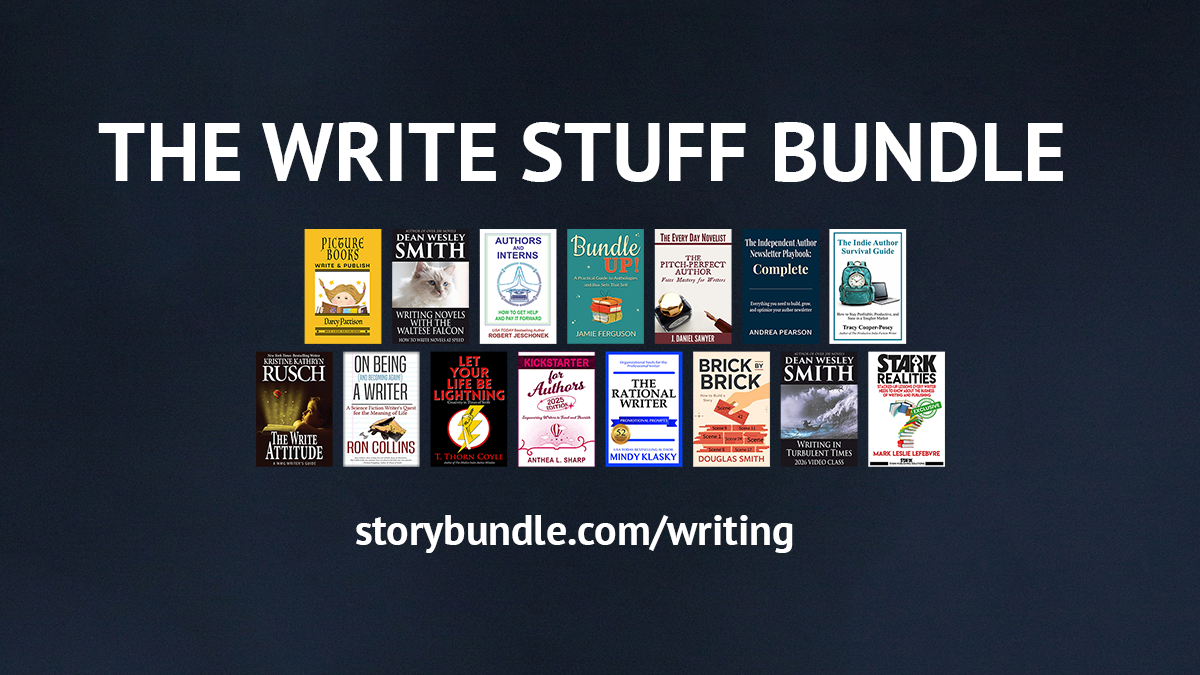
Brick by Brick: How to Build a Story is available now in the Write Stuff StoryBundle, curated by Kristine Kathryn Rusch. 15 exclusive books on writing and publishing—pay what you want, starting at $5. Customers can choose to direct a portion of their payment to World Central Kitchen. The bundle runs through May 14, 2026.