
Interview: Tracy Cooper-Posey on The Indie Author Survival Guide

Tracy Cooper-Posey has published over 200 titles across multiple genres and pen names, runs Stories Rule Press with her husband, manages a city magazine, and maintains The Productive Indie Fiction Writer—a site and book series focused on helping authors build durable, systems-based careers. Which is to say: when Tracy talks about sustainability, she’s talking from a vantage point most of us don’t have.
Her contribution to the Write Stuff StoryBundle is The Indie Author Survival Guide—a clear-eyed look at what’s changed in indie publishing, why the old playbook stopped working, and how to build a writing career that lasts.
The Interview
You’ve published over 200 titles across multiple genres and pen names, run a micropress with your husband, manage a city magazine, and maintain The Productive Indie Fiction Writer. This is a lot! How do you manage to do it all?
Chronic sleep deprivation is key.
Actually—no. I sleep very well; it’s essential for your health, sanity, and creativity. Creativity is the first thing to go if you’re even a little sleep deprived.
But I do work long hours. I like my work, though, and that makes a difference. And I am very organized.
Everything runs on systems, schedules, and priorities that shift depending on what’s most important right now. I batch work heavily, reuse assets wherever possible, and try to make every piece of work do more than one job. A blog post might become a book chapter. A release feeds the newsletter, the store, and social media with minimal extra effort.
My days are broken into buckets of time devoted to current priorities. I rely heavily on a task manager, which lets me stop trying to remember everything and concentrate fully on what I’m working on.
The other piece is that I’ve been doing this a long time. What looks like a lot is actually the accumulation of processes built over years. Once something works, I keep it and refine it instead of reinventing it.
Also, I’m very comfortable letting things be “good enough.” If I tried to make everything perfect, nothing would get done.
Your book starts off by talking about how the ground shifted for indie authors. Strategies deemed tried and true no longer work. Algorithms have changed. Discoverability is harder. What made you realize the landscape had fundamentally shifted?
It wasn’t one moment. It was a pattern.
Sales that used to be predictable stopped being predictable. Platforms that used to provide visibility started requiring paid support to get the same reach. Tactics that had worked reliably for years suddenly produced weaker and weaker results.
When you’ve been watching the business side of publishing for a long time, you start to recognize when something is a temporary dip and when it’s structural change. This felt structural.
The biggest signal, for me, was that relying on any single retailer or platform started to feel fragile. That’s when I began shifting more attention toward direct relationships with readers and away from depending on algorithms behaving nicely.
The Indie Author Survival Guide is framed around sustainability and playing the long game. Why do you feel this approach is so important?
Because most writing careers fail from exhaustion, not lack of talent.
It’s very easy to build a system that works for six months and then burns you out completely. Indie publishing has a way of rewarding intensity in the short term, which can mask the fact that the approach isn’t sustainable.
If you want a career that lasts years or decades, you need processes you can keep using even when life gets complicated, energy dips, or the market shifts again.
The long game also gives you leverage. Your backlist grows. Readers accumulate. Systems improve. You’re not starting from zero every time you release something new.
Sustainability isn’t glamorous, but it’s what makes everything else possible.
In your book you mention that having an experimental mindset is important for today’s indie authors. Why do you feel this way?
It has always been true that what works for one author might not work for another. In addition, these days, nothing stays stable long enough to rely on it indefinitely.
What works today may not work a year from now, and waiting for certainty usually means you’re already behind. An experimental mindset lets you test ideas quickly, keep what works, and discard what doesn’t without getting emotionally attached to any one approach.
It also reduces the fear factor. If something is an experiment, it doesn’t have to succeed. It just has to teach you something.
Over time, those small experiments add up to a much more resilient business, because you’re constantly adapting instead of reacting late.
The Productive Indie Fiction Writer is a site and book series focused on helping indie authors build durable, systems-based careers. What does “systems-based” mean to you, and how does this manifest in your own career?
A system is something that works without you having to rethink it every time.
In a systems-based career, you’re not asking, “What should I do today?” You already know. There’s a workflow for writing, publishing, marketing, and communication, and those workflows connect to each other.
In my own career, that shows up in things like modular email sequences, repeatable launch processes, content that can be repurposed across formats, and a clear structure for moving readers from discovery to long-term engagement.
It also means separating decision-making from execution. I decide once, build the system, and then let the system carry the workload going forward.
If you were starting your author career today, what are the key things you’d focus on from day one?
First, I would focus on writing consistently and finishing work. Without that, nothing else matters.
Second, I would start building a direct connection with readers immediately; an email list, even if it’s tiny. That relationship is one of the few assets you truly control.
Third, I would choose a manageable scope. It’s tempting to try everything at once, but that usually leads to scattered effort and slow progress. I’d pick one genre, one core strategy, and get traction before expanding.
And finally, I’d assume that everything I try is temporary. I’d build with the expectation that I’ll need to adapt, rather than hoping I’ve found a permanent solution.
What are you working on now—and what’s fun or exciting about it?
Right now, I’m focused on expanding our direct sales at Stories Rule Press, which has been both challenging and interesting. It’s a different way of thinking about publishing. It’s less about visibility on platforms and more about building a relationship with readers over time.
On the fiction side, I am, as always, rotating through my three pen names, writing and releasing stories as regularly as possible. When you’ve written and released a lot of work, the fun becomes revisiting mature story worlds and familiar characters and exploring new pockets of those worlds. And because I have a great relationship with my readers, the feedback is great; they love revisiting those worlds, too. Then there’s the excitement of new series…I always have something interesting in the works.
And I’m always working on refining systems; finding ways to make the business run more smoothly without increasing the workload. That’s the kind of puzzle I enjoy, even if it sounds a bit dry on the surface.
About the Author
Tracy Cooper-Posey is a multi-genre author with more than 200 titles published across romantic suspense, historical fiction, fantasy, science fiction, and women’s fiction. A three-time Aurealis Award finalist (2023, 2024 & 2025), she writes under three pen names—Tracy Cooper-Posey, Cameron Cooper, and Taylen Carver—all of which have been recognized as Aurealis finalists.
She is a winner of the Emma Darcy Award, an SFR Galaxy Award recipient, and a fourth-place finalist in Hugh Howey’s SPSFC #2. With over two decades in independent publishing, Tracy has built a sustainable, long-term career through structure, systems, and strategic adaptation.
She currently serves as Managing Editor of a city magazine while writing full-time from Edmonton, Canada, where she and her husband, Mark Posey, run the micropress Stories Rule Press.
Tracy is also the creator of The Productive Indie Fiction Writer, a long-running site and book series focused on helping independent authors build durable, systems-based careers in a rapidly changing market.
Fueled by Irish Breakfast tea, dark chocolate, and an enduring love of genre fiction, she writes both fiction and nonfiction with the same goal: helping storytellers—and story-lovers—thrive.
Find Tracy
- The Productive Indie Fiction Writer
- Tracy Cooper-Posey
- Cameron Cooper — pen name
- Taylen Carver — pen name
- Stories Rule Press (direct sales)
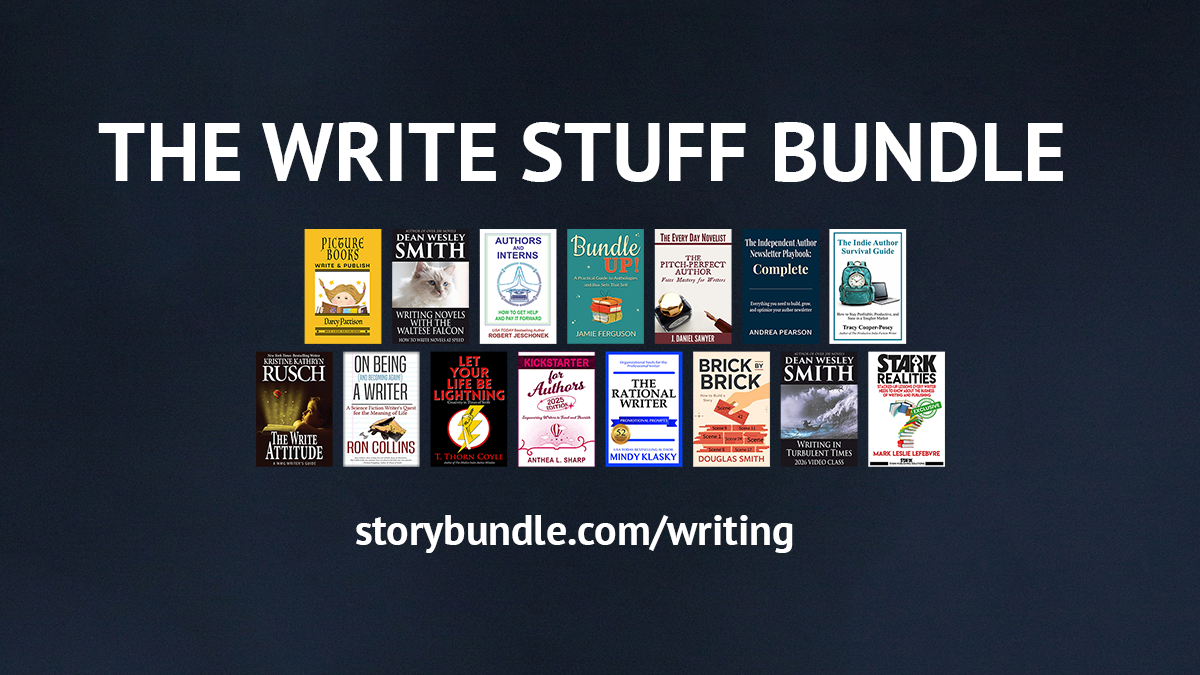
The Indie Author Survival Guide is available now in the Write Stuff StoryBundle, curated by Kristine Kathryn Rusch. 15 exclusive books on writing and publishing—pay what you want, starting at $5. Customers can choose to direct a portion of their payment to World Central Kitchen. The bundle runs through May 14, 2026.