Interview: Ron Collins on For the Heart of the Game

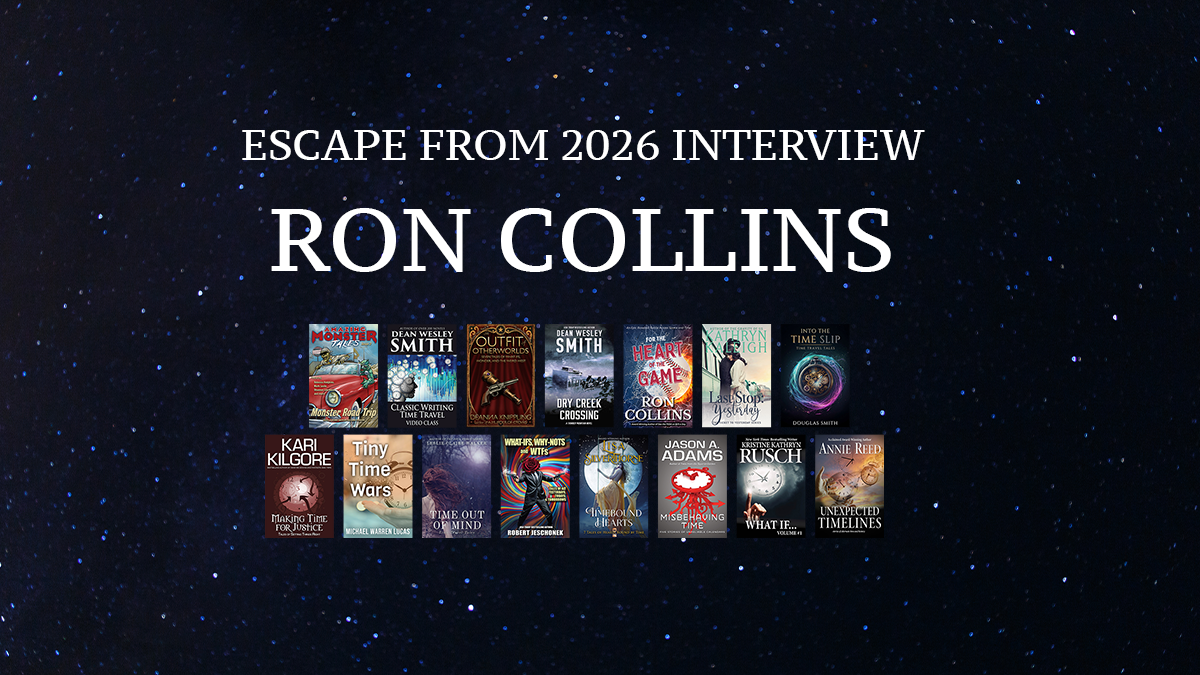
For the Heart of the Game, by Ron Collins, sends thread-worn sportswriter Casey Neal—a man who’s crossed timelines, faced down crime lords, and saved baseball more times than his therapist will ever know—through a wormhole into a world where the game’s stats are disappearing and its managers are vanishing without a trace. From the neon-lit sports bars of 2061 to the ivy-covered walls of Wrigley Field in 1961, Casey, his old friend Don-o, and a sharp-witted waitress named Denise chase a conspiracy that threatens not one league but every version of baseball across space and time. Because without the game, nothing else matters.
The Interview
Casey Neal is an “intrepid baseball hack. Man without a home,” a guy whose “lot” is “to be self-centered, even when no one cares.” What does a tired, wry, self-aware narrator like Casey let you pull off in a time-travel story that a wide-eyed one couldn’t?
I’ve been thinking quite a bit about Casey and his buddy, Don-o. Arguably, while this book is a stand alone, the “story” of Casey and Don-o changes over three books, and their relationship to the books has parallels to Nick Carraway and Jay Gatsby in The Great Gatsby. At the beginning, both are college-aged knockabouts trying to figure out who they are. It turns out that Don-o has a fate, though, and it’s only Casey who is untethered. He’s going take most of his life trying to answer that question of who he is.
I think it’s that essence of being untethered that makes him compelling as a narrator in a time-travel (and alternate history) tale. At the end of the day, time travel is all about our identity at point A and at point B, right?
You love baseball! What is it about this sport that makes you love it so?
Oh my. Hmm. Well, at its heart, baseball is the most mathematically beautiful game of all sports, and I argue it’s the most human. The pace is languid, until it’s not. It’s played by people who have a lot of time to think—sometimes too much time—but at the same time, it’s athletic and demanding of instant decision making in ways other sports aren’t. I also like the idea of the grind of the season. A baseball team plays essentially every day for seven months. That’s a long haul. Like a life, kind of?
I really enjoy other sports, too, but they operate differently. Basketball, hockey, and international football are beautiful sports full of flow and momentum. US football is about physicality on one side, but also requires the coordination of a ballet and the intellectualism of chess. I can get interested in them, too. But the whole of what baseball is … it’s just more compelling for me.
Baseball is arguably the most measured sport there is—and the conspiracy here is literally someone stealing the game’s stats and disappearing its managers. Did the engineer in you shape how the mystery is built, or how the time-travel rules hold together?
I’m not sure how to answer that. [grin] I can say that, for me, one of the complexities of writing time travel is to make sure the loops hold together. Sometimes the reader is likely to get lost (and sometimes I get lost writing them!). As such, I sat down early in the process and developed a one-page space-time diagram that laid things out and then helped me focus on what loops existed and how time warped in each.
The book runs from the neon-lit sports bars of 2061 to the ivy on the walls of Wrigley in 1961. When you move the game across all that time, what stays exactly the same about it, and what did you have the most fun letting change?
That gets into the alternate history of it all, I suppose. This story has Casey and Don-o spend time in two fictional timelines that are essentially multiverse offshoots of ours, and then also in 1961 of our timeline. The goal, of course, is to be accurate on all our world history, and to incorporate that into the story so that it actually has an influence.
I should say that I built the two fictional timelines (in which the baseball leagues are the PEBA and the BBA rather than the MLB). These two worlds do actually exist in the form of computer simulations. So another part of the fun was intertwining “real” events from those environments and the people who formed their basis into something new.
Don-o—bearded, Hawaiian-shirted, perpetually three days past a shave—is the one who yanks Casey through the wormhole, but he’s also the person Casey actually shares the love of the game with. In a book full of crime lords and vanishing leagues, what did you want that friendship to hold down?
Earlier, I said I’ve been thinking about Casey and Don-o as Nick and Gatsby. I think this is true, but to get it really right, you have to reverse the polarity on Gatsby/Don-o. Where at first Nick sees Gatsby as a great man, only to find out at the end that he’s not quite that, Casey and Don-o start out as a couple boyhood friends, which means Casey gets to watch Don-o become something powerful and mythic in all ways that are good.
Through it all, though, I hope it’s clear that regardless of where their lives take them, at their hearts they will always be those boyhood friends.
When you say baseball is the thing worth saving, whose conviction is that—Casey’s, yours, or some of both?
I suppose it’s some of both. But in the worlds of For the Heart of the Game, where baseball is a special thing, I suppose it’s even stronger. Maybe I should see Casey and Don-o as Sam and Frodo!
How much of Casey’s history did you have in your head while writing this one—and is this a guy you see hauling readers back through the wormhole again?
As noted, this is the third time Casey and Don-o have run together, so there’s some history already in pages. I’ve written these mostly “into the dark,” so that history grew organically from a pair of characters I understood firmly to begin with. That connection with characters is something I need to have a handle on if I’m going to write without outlining ahead a bit.
I have ideas for one more book, so we’ll see where it goes from here.
What are you working on now—and what’s fun or exciting about it?
So many things. I am trying to finish more books in the Cruise Brothers universe that I write with my brother, who is a musician in Long Beach. And I’m working on a new collection that maybe I’ll Kickstart later in the year. I’m also dug in on one more project that will remain secret for a short while longer. (hehehe!)
About the Author
Ron Collins is a bestselling Science Fiction and Dark Fantasy author who writes across the spectrum of speculative fiction. With his daughter, Brigid, he edited the anthology Face the Strange.
His short fiction has received a Writers of the Future prize. His short story “The White Game” was nominated for the Short Mystery Fiction Society’s 2016 Derringer Award. He holds a degree in Mechanical Engineering and has worked to develop avionics systems, electronics, and information technology before chucking it all to write full-time.
Find Ron
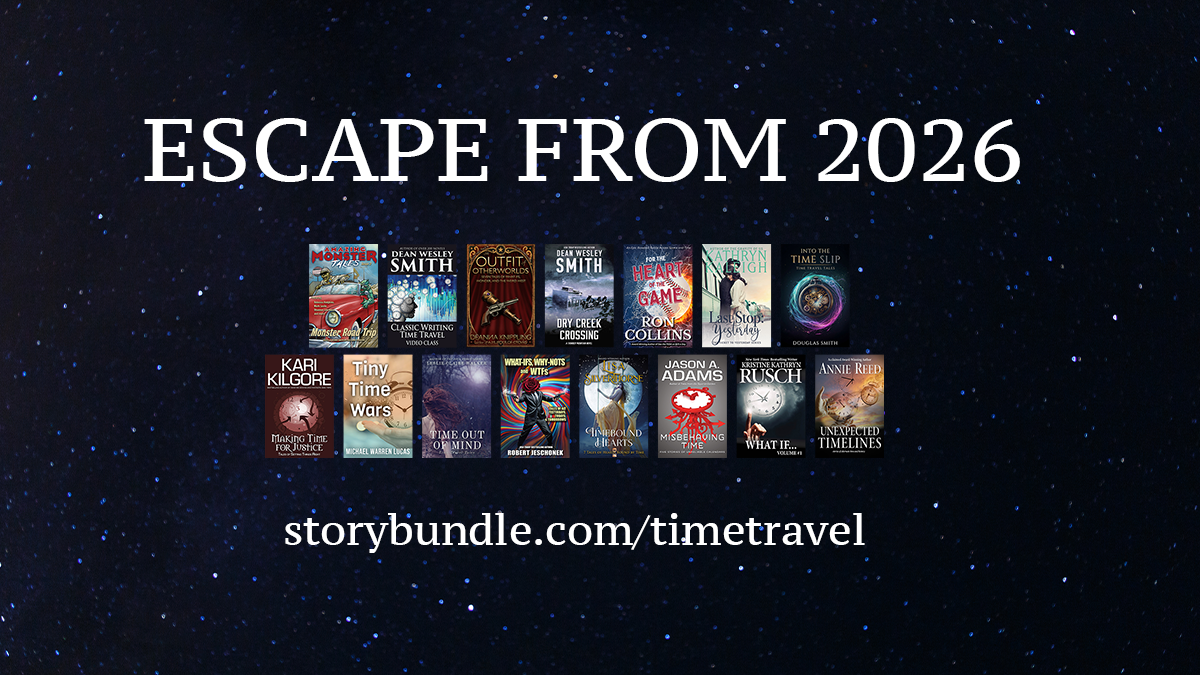
For the Heart of the Game is available now in the Escape from 2026 StoryBundle, curated by Kristine Kathryn Rusch. 15 exclusive books of alternate history and time travel—pay what you want, starting at $5. Customers can choose to direct a portion of their payment to World Central Kitchen. The bundle runs through June 25, 2026.