

Interview: Annie Reed on Unexpected Timelines
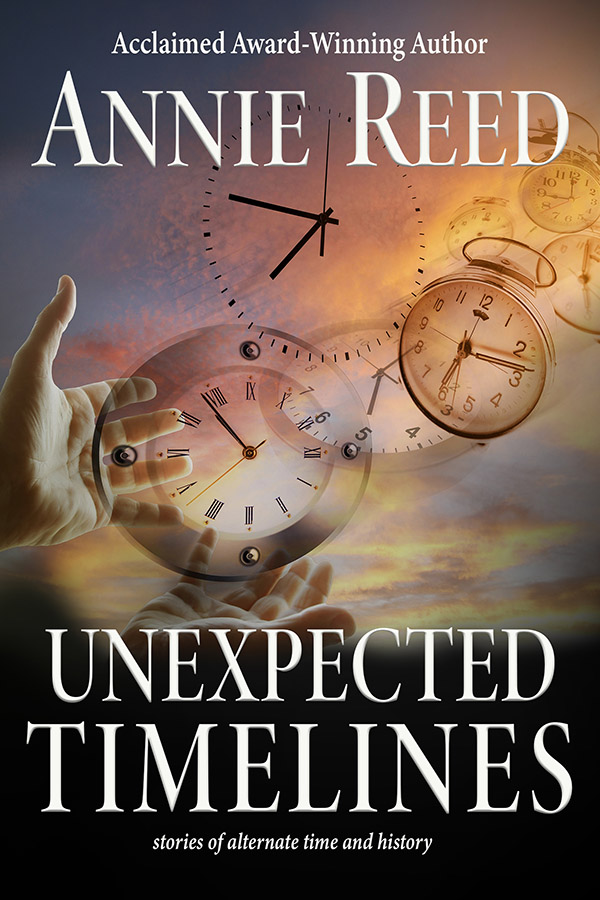
Unexpected Timelines carries Annie Reed’s complete, author-preferred edition of the novella “Comstock” — a story of crime, romance, and the theater set in 1883 Virginia City at the height of the silver rush. It anchors a fantastic collection of time-travel and alternate-history tales that run from broad comedy to hard-edged crime.
The Interview
You’ll put a story with a goofy delight like Big George the alien right next to one about a widow hunting down the truth of her husband’s murder. Which kind of story is harder to pull off for you, the funny or the serious?
Big George, oh man, he was a blast to write. I had his character voice firmly in mind when I started that story. The lead character in “Hellfire” was tougher because she was such a self-contained, pragmatic woman, so I suppose between those two stories, the serious “Hellfire” was harder to write. That’s not exactly the question you asked, but for me, it all comes down to character not tone.
Kris notes your westerns carry an accuracy only someone who actually lives in Nevada can manage. What’s something about writing a story set in 1883 Virginia City at the height of the silver rush that you’d never get right from just research alone?
That’s a hard question to answer. I’ve lived in Northern Nevada all my life, so the things other people might not notice about this area, I take for granted because I’m so used to it.
That said, I think it would be difficult to get an actual feel for what life must have been like in 1883 Virginia City just from research alone. Virginia City’s actually at a pretty high elevation (over 6,000 feet above sea level), so the air is thinner than people who don’t live here realize. Plus the city can get downright cold and windy. Most people think of Nevada as one big desert that’s hot all the time, but it does snow here, especially in places like Virginia City. Nevada’s also big. It takes time to get from one part of the state to another. It’s an eight-hour drive through a whole lot of empty desert to get from Reno to Las Vegas, for just one example. I can just imagine how long it would take to get to Virginia City from San Francisco in 1883. That would be one long, arduous, dirty journey.
I did do a lot of research to get a visual idea of what the city looked like in 1883. Where the buildings were in relation to each other. Some of those buildings are still standing today. Over the years I’ve spent a lot of time walking around the city and going through some of those buildings. For example, events are still held in Piper’s Opera House, which was rebuilt after the fire referred to in the story and has since been brought up to code. When you’re actually in a place and experiencing it in real life, you get a lot of sensory input you can’t get from just doing research.
Big George tells his own story like he’s leaning on a fence post—swearing he’s “as human as the next fella” a breath before admitting he’s just not from this time zone. What does a confiding, tall-tale voice like that let you get away with that a straighter telling wouldn’t?
A guy like Big George can tell a somewhat meandering tale because it’s pretty clear it’s his story and he’s going to take his own sweet time telling it. We all know people like that. People who tell us stories about their past and the things they’ve done, and while we know they’re embellishing those stories, the stories are just so interesting we don’t care.
That’s the trick, I think. To make a meandering tale interesting enough to hold a reader’s attention. That would be a whole lot harder to pull off in a straighter telling.
“Comstock” appears here as your complete preferred version for the first time—a tale of crime, romance, and the theater set in the 1883 silver rush. What does it mean to you to have your preferred version of this story out in the world?
It means a whole lot. I had to dial back the crime aspects of the story in the original version and get to the romance faster, which I thought did a disservice to the characters and their subsequent actions. I always wanted to expand the story to what I originally wanted it to be and give the main character a much larger role in resolving the crime in a satisfactory manner. The preferred version let me do that.
In several of these stories, you leave it genuinely open whether the time travel happened at all. What do you like about handing a reader a tale you’re not going to resolve for them?
That’s interesting. From my perspective, there’s only one story in the collection that leaves it open to the reader about whether the time travel happened or not.
Since I write a lot of mysteries and crime stories, I’m used to writing stories that resolve that crime or mystery by the end of the story. I personally prefer writing (and reading) stories that resolve one way or the other by the end. That’s the mystery writer in me. I like stories that impose order on chaos.
But every once in a while I come across a character who wants to tell a story that may or may not resolve because of the way the character’s telling it. If the character’s engaging enough and the tale they’re telling is interesting enough, I don’t mind the fact that there’s no concrete resolution. I just hope readers feel the same way.
You co-write the Gray Lady space opera novels with Robert Jeschonek—who’s also in this bundle with his collection What-Ifs, Why-Nots and WTFs. What’s it like switching between writing solo and building a whole world with a collaborator?
First of all, working with Bob (Robert Jeschonek) is a blast! He’s got such a wonderful, unique voice and perspective, co-writing with him really gets me to think outside my own box. He dreams up twists and turns and creatures that I would never come up with, not in a million years.
Usually writing is such a solo thing—sitting somewhere by yourself and making shit up—that it’s difficult to find someone to bounce ideas off of. Co-writing with Bob gives both of us the opportunity to say, “Hey, what if we do this?“ And the other person will say, “Great! Then we can do that.“ And it just snowballs from there. Plus neither one of us has an ego that gets in the way of the other person’s suggestions.
The one thing Bob and I decided early on because our writing styles are so vastly different was to each write first-draft chapters for specific characters and alternate between those chapters. Not quite a round-robin thing, but close. In that way, we’re still writing solo chapters while the project as a whole is co-written.
I suppose the biggest difference for me between solo writing and co-writing is that when I write by myself, I write into the dark. No outline. No character sheets. Sometimes not even a title. Something will give me an idea, often it’s a picture or piece of art or an opening line, and off I go.
I can’t do that when I’m co-writing with Bob. We need to be on the same page, so to speak, before we start. So we’ll discuss the project, come up with a general idea, and one of us will write up something I call a treatment. (I refuse to call it a proposal because I hate those things.) The treatment is just a few paragraphs about what we discussed and the eventual goal we’re trying to get to by the end of the project. We usually end up deviating from that treatment a bit as we write, but at least we have a roadmap of sorts when we start.
What are you working on now—and what’s fun or exciting about it?
I’m writing a story for the winter issue of Romance for All Seasons: Winter Wonderland, the quarterly romance anthology I co-edit with David H. Hendrickson. I just finished a story for Thrill Ride Magazine, so switching over from thriller to sweet romance is a lot of fun. This story incorporates a really cool Asian-themed festival I go to every year with my daughter, so it’s fun to relive those experiences through the eyes of a character who’s going to find unexpected romance on a cold winter night. Of course, it will be up to Dave whether my story makes it to the final cut.
Then I’ll get busy on copyedits for the fall edition of Romance for All Seasons, which is also a blast. David and I have already agreed on the stories for this issue. We have some really great ones this time around, and we can’t wait for everyone else to get a chance to read them!
About the Author
Acclaimed author Annie Reed has been called “one of the best writers of her generation” and for good reason. She writes in multiple genres, including mystery and suspense, science fiction, thrillers, romance, and urban and contemporary fantasy, along with the occasional story that doesn’t fall into any one specific category.
She’s a founding member and frequent contributor to the innovative Uncollected Anthology, now in its eleventh year of publishing themed urban and contemporary anthologies three times a year. Her short fiction appears regularly in Pulphouse Fiction Magazine; Mystery, Crime & Mayhem; and Thrill Ride Magazine. Along with bestselling writer Robert Jeschonek, she’s the co-author of the popular Gray Lady series of space opera novels. She currently writes and edits fulltime.
Find Annie
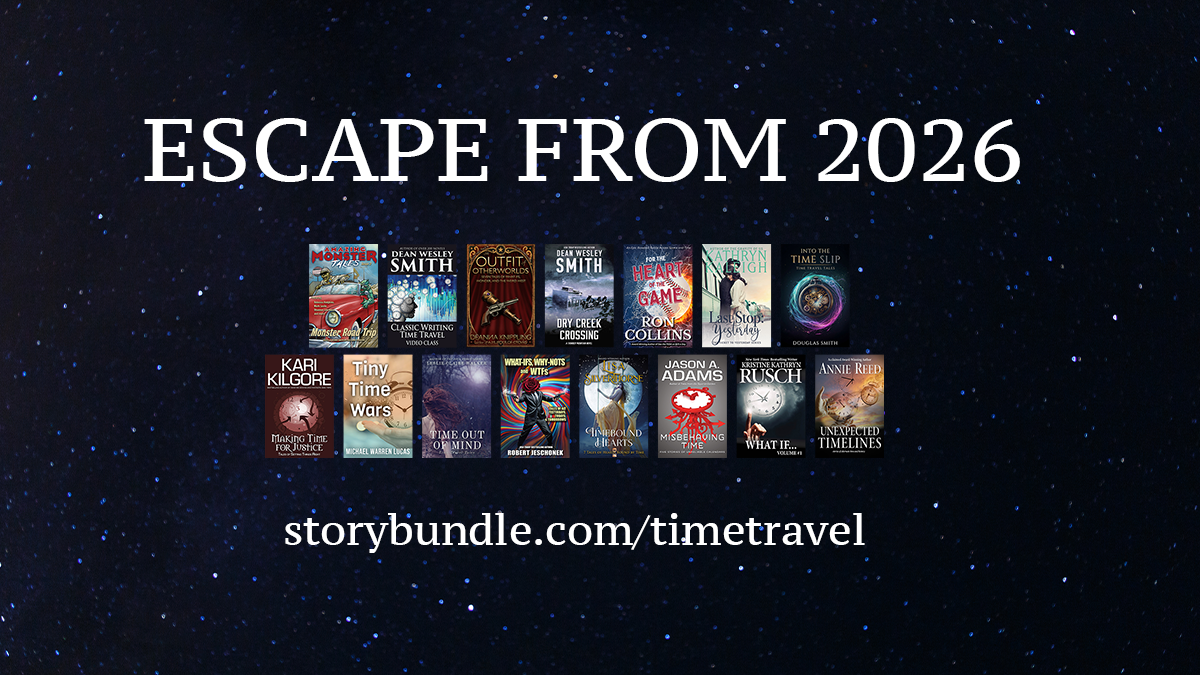
Unexpected Timelines is available now in the Escape from 2026 StoryBundle, curated by Kristine Kathryn Rusch. 15 exclusive books of alternate history and time travel—pay what you want, starting at $5. Customers can choose to direct a portion of their payment to World Central Kitchen. The bundle runs through June 25, 2026.